
The KonMari Decluttering Method: A Step-by-Step Guide to Tidying Up
Reading time: 18 minutes
Ever stood in the middle of your living room, surrounded by piles of stuff, and thought: “How did it get this bad?” You’re not alone. In 2026, the average household in the United States contains over 300,000 items — from paper clips to furniture — and a growing body of research confirms that clutter doesn’t just crowd our physical spaces. It crowds our minds, drains our energy, and quietly undermines our well-being.
Enter Marie Kondo and her revolutionary KonMari Method — a philosophy that has sparked a global tidying movement, inspired Netflix specials, sold over 16 million books worldwide, and fundamentally changed how millions of people relate to their possessions. But the KonMari Method is more than a cleaning strategy. It’s a mindset shift. It asks a deceptively simple question: “Does this spark joy?” And from that single question, an entire life can be transformed.
Whether you’re a minimalist-curious beginner or someone who’s already attempted a declutter (and found yourself right back where you started), this guide will walk you through the KonMari Method with precision, honesty, and practical clarity. We’ll go beyond the basics, explore real-world case studies, bust common misconceptions, and give you a concrete roadmap to begin your tidying journey today.
Table of Contents
- What Is the KonMari Method?
- The Core Principles Behind KonMari
- The Six Fundamental Rules of Tidying
- The KonMari Category Order: Why Sequence Matters
- The “Spark Joy” Test — More Complex Than It Sounds
- Real-World Case Studies: KonMari in Action
- Common Challenges and How to Overcome Them
- KonMari vs. Other Decluttering Methods
- KonMari by the Numbers: What the Research Says
- Frequently Asked Questions
- Your Tidy Life Starts Now: A Practical Roadmap
What Is the KonMari Method?
The KonMari Method was developed by Marie Kondo, a Japanese organizing consultant and author whose 2011 book The Life-Changing Magic of Tidying Up became a global phenomenon. The method draws on Japanese principles of mindfulness, gratitude, and intentional living, blended with a highly structured approach to physical organization.
Unlike conventional cleaning advice — which typically tells you to tidy room by room and organize as you go — KonMari takes a radically different approach. It asks you to sort by category, not by location, and to make a single decisive pass through your belongings, keeping only what genuinely brings value or joy to your life. Everything else is thanked and released.
The method is not merely about getting rid of things. It’s about curating a life — intentionally designing your living space to reflect who you are and who you want to become. By 2026, the KonMari philosophy has evolved beyond the home and now influences workspace design, digital decluttering, and even corporate organizational culture.
“The question of what you want to own is actually the question of how you want to live your life.” — Marie Kondo
The Core Principles Behind KonMari
Before jumping into the how-to, it’s worth understanding the foundational philosophy. The KonMari Method isn’t a quick-fix cleaning hack — it’s grounded in three interconnected principles that give the entire process its transformative power.
1. Tidying Is a Special Event, Not a Daily Chore
One of the most liberating ideas in the KonMari Method is that true tidying is done once and done right. Marie Kondo distinguishes between “tidying” — the deep, category-by-category sorting of everything you own — and “cleaning,” which is the regular maintenance of a tidy space. Most of us spend our lives “cleaning” a messy space without ever actually “tidying” it.
The goal is to complete a single, thorough tidying event that resets your relationship with your possessions permanently. Once done correctly, the KonMari Method promises you will never revert to clutter — because the process changes not just your home, but your habits and values.
2. Your Home Should Reflect Your Ideal Life
Before you touch a single item, the KonMari Method asks you to visualize your ideal lifestyle in vivid detail. What does your bedroom look like in the morning? How does it feel to walk into your kitchen? What kind of person lives in this space?
This visualization step isn’t fluff — it’s strategic. It anchors every decision you make during the tidying process to a clear destination. Without it, “decluttering” becomes an aimless exercise in moving things from one pile to another.
3. Every Object Has Energy and Deserves Respect
Rooted in the Japanese Shinto tradition, the KonMari Method treats possessions as entities worthy of gratitude and respect. When you discard an item, you thank it for its service. When you store something, you fold it with care. This mindfulness transforms the act of organizing from a mundane chore into a meaningful ritual — and that shift in attitude is precisely what makes the results last.
The Six Fundamental Rules of Tidying
Marie Kondo outlines six core rules that govern the entire KonMari process. Think of these as your operating principles — ignore them, and the method loses its effectiveness.
- Commit yourself to tidying up. This is an all-in endeavor. Half-measures don’t work.
- Imagine your ideal lifestyle. Visualize before you act. Clarity of destination shapes every decision.
- Finish discarding first. Do not begin organizing until you have completed the sorting and discarding process entirely.
- Tidy by category, not by location. Gather all items in a single category from across the entire home before evaluating them.
- Follow the right order. Work through categories in the prescribed sequence (more on this below).
- Ask yourself if it sparks joy. This is the ultimate test for deciding what stays and what goes.
Each rule is interdependent. Skipping one weakens the whole system. For example, tidying by location (cleaning one room at a time) is the single most common mistake people make — it prevents you from seeing the full scope of what you own and leads to items being shuffled rather than evaluated.
The KonMari Category Order: Why Sequence Matters
The KonMari Method specifies a deliberate sequence for working through your belongings. This order is not arbitrary — it’s designed to build your decision-making confidence gradually, starting with the categories that are emotionally easiest and ending with the most complex.
Category 1: Clothing
Clothing is the ideal starting point because it’s tangible, personal, and relatively low in sentimental weight (compared to, say, family photos). The process: gather every single item of clothing from every location in your home — closets, drawers, under the bed, storage boxes — and pile them all on the floor. The visual impact of this pile alone is often a revelation.
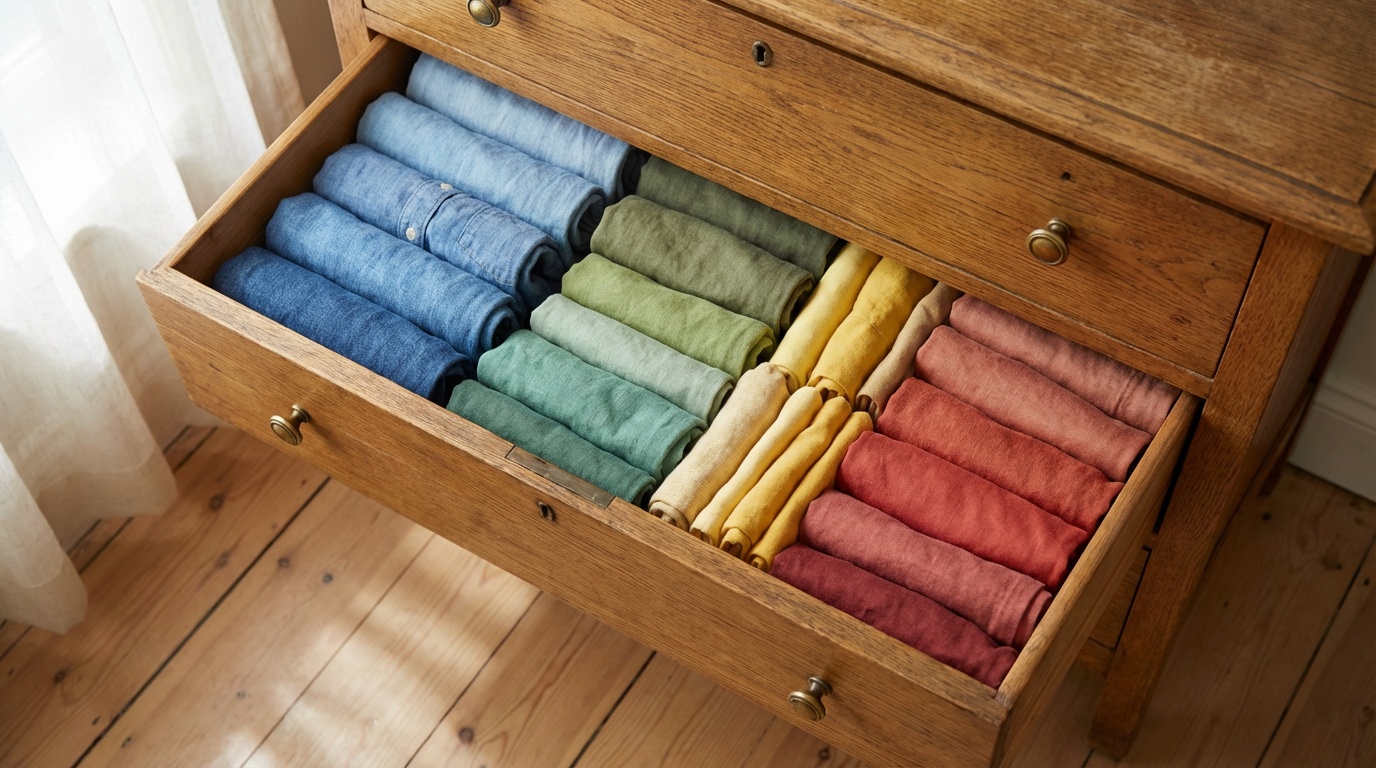
Then, pick up each item individually, hold it, and ask: does this spark joy? Items that do are kept. Items that don’t are thanked and set aside for donation or disposal. Marie Kondo’s iconic clothes-folding technique — the vertical fold — is introduced at this stage, turning folded clothing into neat rectangles that stand upright in drawers, making every item instantly visible.
Category 2: Books
Books carry significant identity weight for many people. We keep books we haven’t read in years because they represent who we aspire to be. The KonMari Method challenges this honestly: an unread book that sits on your shelf unchosen for years is not serving you. Gather all books, place them on the floor, and evaluate each one physically — not by title or memory, but by touch.
Category 3: Papers
Paper is the arch-nemesis of most households. The KonMari rule for paper is blunt: discard everything unless it falls into one of three categories — currently in use, needed for a limited time, or must be kept indefinitely. Old manuals, expired warranties, utility bills from 2019 — gone. Digitize what you must keep; discard everything else.
Category 4: Komono (Miscellaneous Items)
Komono is the Japanese word for small miscellaneous items, and this category is by far the largest. It includes kitchen items, bathroom products, hobby supplies, electronics, tools, and all the random odds and ends that accumulate over a lifetime. Kondo recommends working through komono in sub-categories, tackling the most functional items first before moving to décor and sentimental pieces.
Category 5: Sentimental Items
Photos, gifts, heirlooms, mementos — these are saved for last for a reason. By the time you reach this category, you will have sharpened your ability to recognize what genuinely sparks joy versus what you’re keeping out of guilt or obligation. Handling sentimental items too early in the process — before your decision-making instincts are calibrated — often leads to keeping too much or making decisions you later regret.
The “Spark Joy” Test — More Complex Than It Sounds
The phrase “spark joy” has become so culturally ubiquitous that it risks being dismissed as cutesy or trivial. But in practice, the spark joy test is a sophisticated tool for cutting through rationalization and accessing your genuine emotional response to an object.
Here’s how it works in practice: hold an item in both hands and pay attention to your body’s response. Do you feel a lift — a subtle warmth, a sense of energy, a smile? Or do you feel nothing, or perhaps a slight heaviness? That physical signal is your intuition speaking. It bypasses the mental gymnastics we use to justify keeping things (“but it was expensive,” “but I might need it someday,” “but Grandma gave it to me”).
Pro Tip: If you’re struggling to feel a response, try holding an item you absolutely love first — a favourite sweater, a cherished book — to calibrate your baseline for “joy.” Then compare how other items feel against that benchmark.
It’s also worth noting that “spark joy” doesn’t mean every object must make you giddy. A toilet brush doesn’t need to bring you delight — but it should feel right, useful, and deserving of its place in your home. The question for functional items is slightly reframed: does keeping this serve the life I want to live?
Real-World Case Studies: KonMari in Action
Case Study 1: The Overwhelmed Family Home
In 2025, a family of four in Portland, Oregon shared their KonMari journey on a popular homesteading blog. With three kids under the age of ten, their 2,100-square-foot home had reached a state of entropy that was affecting the family’s daily functioning — morning routines were chaotic, the kids couldn’t find their belongings, and both parents reported chronic low-grade stress at home.
They committed to a KonMari overhaul over six weekends. Beginning with clothing — which produced a staggering pile of 847 individual garments — they ultimately retained 312 items and donated the rest. By the time they reached sentimental items, the process had become almost meditative. The outcome: significantly reduced morning prep time, a dramatic reduction in household arguments about “lost” items, and — most unexpectedly — the children became more engaged in maintaining tidiness because they had participated in choosing what stayed.
The mother noted: “We didn’t just clean our house. We redesigned how our family lives inside it.”
Case Study 2: The Remote Worker’s Home Office
As hybrid and remote work remain standard in 2026, the home office has become one of the most cluttered spaces in modern households. A freelance graphic designer in Toronto applied the KonMari Method specifically to her workspace in early 2026, having noticed that visual clutter was directly impacting her creative output and focus.
She began by applying the KonMari category framework to her office: papers first (eliminating 14 years of printed client files and reference materials, retaining only active projects), then komono (cables, office supplies, outdated tech), then books. The process took three full days. The result was a workspace containing only items that actively supported her work and creative process.
Three months later, she reported a measurable improvement in productivity — her self-assessed deep work sessions increased from an average of 2.3 hours per day to 4.1 hours per day. “The clutter wasn’t just physical. It was mental. Clearing the space cleared my head,” she wrote.
Common Challenges and How to Overcome Them
Challenge 1: The Guilt Trap
The single greatest obstacle most people encounter during a KonMari session is guilt. The expensive dress bought for an occasion that never came. The exercise equipment purchased in optimism. The gifts received from people you love. Letting go of these items feels like letting go of money, potential, or relationship.
The KonMari reframe: Every item has already served a purpose, even if that purpose was simply the joy of purchase or the expression of love from a giver. Recognizing this allows you to release the item with gratitude rather than guilt. You’re not failing it — you’re completing its purpose and freeing it to serve someone else.
Challenge 2: Perfectionism Paralysis
Many people abandon the KonMari process midway because they can’t make decisions fast enough, or because the pile of discards feels unmanageable. They start sorting donation bags into sub-categories, researching best resale prices, and second-guessing every decision. The process stalls.
The fix: Set a decision timer. Give yourself a maximum of 10 seconds per item during the initial pass. If you’re agonizing, the item is likely not sparking joy — it’s sparking guilt or fear. Trust your first instinct. You can always revisit the discard pile later, but momentum is everything in the early stages of a KonMari session.
Challenge 3: Family Resistance
What happens when you’re committed to KonMari but your partner or housemates are not? This is a common and potentially relationship-straining challenge. Marie Kondo is clear on this point: you never KonMari someone else’s belongings without their consent. Doing so is not just ineffective — it’s a violation of their autonomy and tends to create significant conflict.
The strategic approach: Lead by example. Begin with your own belongings and shared spaces only. Invite rather than impose. Share the positive changes you experience — better sleep, less stress, morning routines that actually work. Most resistant partners come around when they see concrete, tangible improvements in daily life.
KonMari vs. Other Decluttering Methods
How does KonMari stack up against other popular decluttering approaches? The table below compares five key dimensions across four widely used methods.
| Dimension | KonMari | The Minimalist Game | Swedish Death Cleaning | Room-by-Room Method |
|---|---|---|---|---|
| Core Philosophy | Joy-based curation | Gamified reduction | Legacy & burden reduction | Location-based tidying |
| Approach | Category-by-category | Daily incremental removal | Life-stage reflection | Room at a time |
| Time Commitment | Intensive (weeks to months) | 30 days structured | Ongoing lifestyle | Flexible, ongoing |
| Best For | Deep transformation | Beginners, gamification fans | Older adults, life transitions | Maintenance cleaning |
| Emotional Depth | Very high | Low to moderate | High | Low |
KonMari by the Numbers: What the Research Says
The KonMari Method isn’t just a lifestyle trend — it’s backed by a growing body of research connecting organized environments to measurable improvements in mental health, productivity, and overall quality of life. Here’s a visual breakdown of key data points from 2024–2026 studies.
Impact of Decluttering on Well-Being (2024–2026 Research)
Sources: Journal of Environmental Psychology (2025); KonMari Media Global Survey (2026)
A 2025 study published in the Journal of Environmental Psychology found that individuals who completed a full KonMari process reported a 34% reduction in decision fatigue in daily life — not just at home, but at work and in social situations. The researchers theorized that practicing decisive, values-based choices about physical objects trains the brain to approach all decisions with greater clarity and confidence.
Furthermore, a 2026 KonMari Media global survey of 11,400 respondents across 22 countries found that 71% of people who completed the full KonMari process maintained their organized spaces after 12 months — a significantly higher retention rate than the estimated 20–30% long-term success rate associated with conventional cleaning and organizing approaches.
Frequently Asked Questions
Q1: How long does the KonMari Method actually take to complete?
The honest answer is: it depends on how much you own, how large your space is, and how committed you are to dedicated sessions. For a single person living in a studio apartment, the process might be completed in two to four intensive weekend sessions. For a family of four in a larger home, expect six to twelve weeks of regular commitment — typically several hours per weekend. Marie Kondo herself has noted that the goal is not speed, but thoroughness. Rushing through the process to “get it done” undermines its effectiveness. What matters is that every item receives individual attention and a conscious decision.
Q2: What should I do with the items I decide to discard?
The KonMari Method encourages you to thank each discarded item before letting it go, but it doesn’t prescribe a single disposal method. Practically speaking, your discards will likely fall into several streams: items suitable for donation to charity organizations (clothing in good condition, books, household goods), items for sale through platforms like Facebook Marketplace or local resale apps (furniture, electronics, quality clothing), items for textile recycling programs (worn-out clothing and linens), and items for general waste disposal. In 2026, many municipalities offer dedicated textile and household goods recycling programs — check your local council’s website for current options in your area. The key is to arrange disposal promptly, because discards sitting in bags and boxes in your hallway quickly become new clutter.
Q3: Is the KonMari Method suitable for people with ADHD or anxiety disorders?
This is an important and nuanced question. The KonMari Method’s structured category framework can actually be beneficial for people with ADHD, providing clear sequential steps that reduce the overwhelm of open-ended “just clean your room” instructions. However, the intensive nature of the process — and the significant decision-making demand — can be challenging. Occupational therapists and psychologists working in this space in 2025 and 2026 recommend several adaptations: break sessions into shorter blocks of 20–30 minutes with mandatory breaks; use a decision-making partner or accountability buddy; start with a very small sub-category (one drawer, one shelf) rather than the full clothing category; and approach the process as an ongoing practice rather than a one-time event. For individuals with hoarding disorder or significant anxiety around possessions, professional support from a therapist specializing in this area should accompany — or precede — any major decluttering effort.
Your Tidy Life Starts Now: A Practical Roadmap
You’ve absorbed the philosophy, understood the framework, and seen it work in real lives. Now comes the most important part: beginning. The gap between knowing and doing is where most decluttering journeys die. Here’s your concrete, action-oriented roadmap for the next 30 days.
- Day 1–3: Visualize Your Ideal Space. Before touching a single item, spend 15–20 minutes each day journaling or sketching your vision of an ideal home. How does each room feel? What does your morning routine look like in this space? Get specific and emotional about it.
- Day 4–7: Prepare Logistically. Source donation bags or boxes (aim for at least 10 large bags). Identify your nearest donation centers and their drop-off policies. Clear a weekend in your calendar dedicated to the clothing category. Tell a trusted friend or partner what you’re doing — accountability matters.
- Day 8–14: Tackle Clothing. Commit your first dedicated weekend to clothing. Pull everything out, pile it on the bed or floor, and work through each item with the spark joy test. Fold your keepers using the KonMari vertical fold method and return them to your wardrobe. Bag up discards and arrange collection or drop-off immediately.
- Day 15–21: Books and Papers. Move through these categories with decisive momentum. For papers, your default should be discard — scan or photograph anything you need to reference digitally, then release the physical copies.
- Day 22–30: Komono and Initial Sentimental Items. Work through miscellaneous items room by room, sub-category by sub-category. Save photographs and the most meaningful sentimental objects for last.
In 2026, we live in an era of unprecedented abundance — and unprecedented overwhelm. The rise of conscious consumption, the slow living movement, and growing awareness of the psychological costs of clutter are all pointing toward the same insight that Marie Kondo articulated over a decade ago: the things we own either serve our lives or quietly cost us. The KonMari Method gives you a rigorous, proven, and surprisingly joyful framework for making that distinction.
Your home is not just a storage unit for your possessions. It’s the environment that shapes your mood, your energy, your creativity, and your relationships every single day. What kind of environment do you want to wake up in tomorrow? The answer to that question is worth every hour of sorting, folding, and releasing. Start with one drawer. Trust the process. And let the life you actually want emerge from beneath everything you’ve been keeping just in case.
Article reviewed by Nina Svensson, Interior Architecture & Color Design Consultant, on May 4, 2026