
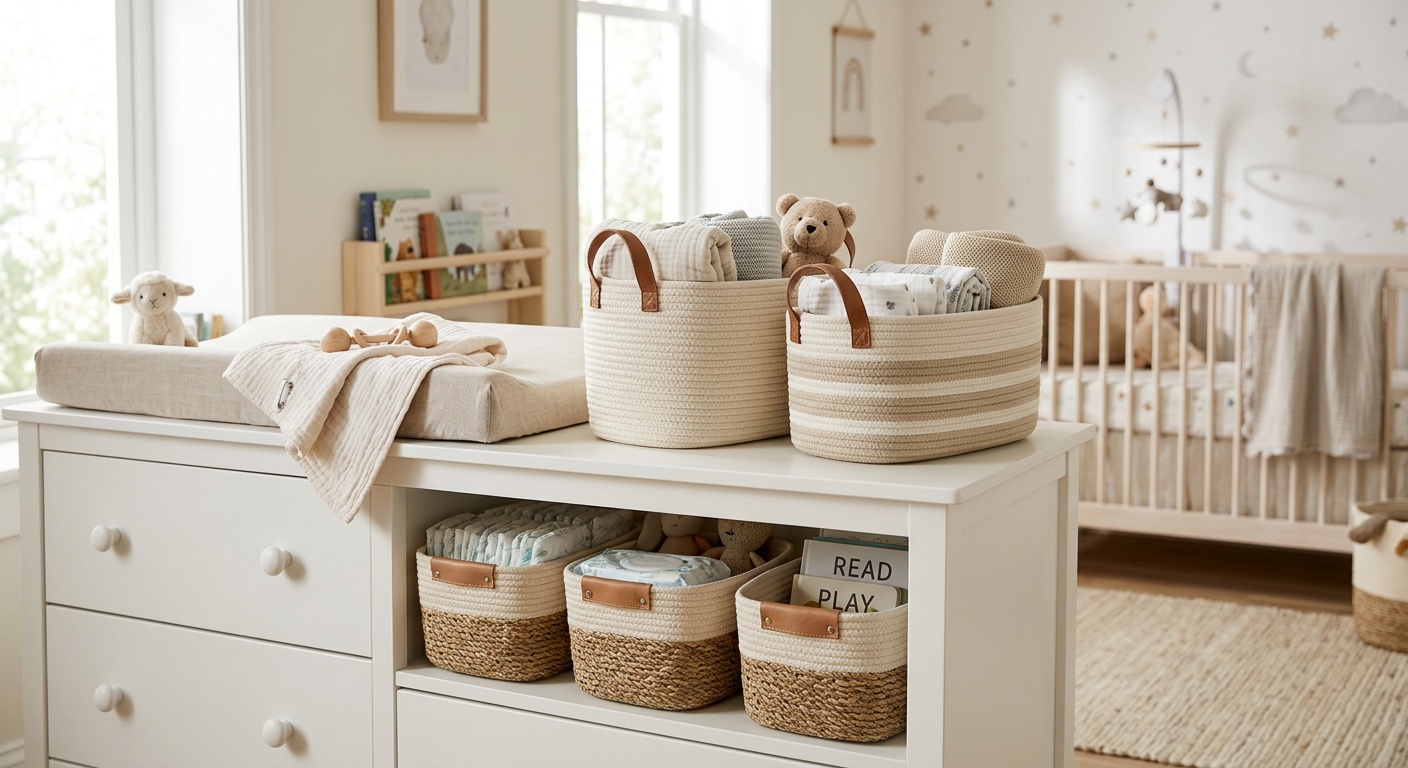
Minimalist Nursery Organization Tips for New Parents
Reading time: 12 minutes
You’ve just brought your baby home. The nursery is a battlefield of gifted onesies, three different types of baby monitors, and a changing table that somehow required a PhD to assemble. Sound familiar? You’re definitely not alone.
Here’s the honest truth most parenting blogs won’t tell you: the chaotic, overstuffed nursery isn’t just aesthetically overwhelming — it’s functionally exhausting. Every extra item you own is one more decision to make at 3 AM when you’re running on 90 minutes of sleep and a lukewarm cup of coffee.
That’s where a minimalist approach to nursery organization becomes less of a lifestyle choice and more of a genuine survival strategy. In 2026, with baby product markets more saturated than ever — the global baby products market is projected to surpass $121 billion — the pressure to buy everything is real. But the parents who thrive in those early months? They’ve learned the art of strategic subtraction.
This guide is your practical roadmap. Whether you’re setting up the nursery for the first time or doing a much-needed reset, you’ll find actionable, specific strategies here that go far beyond “declutter your space.”
Table of Contents
- Why Minimalism Works in a Nursery
- Before You Begin: The Honest Audit
- Building Your Nursery Zones
- Smart Storage Without the Clutter
- Creating a Safe, Comfortable Environment
- Real Parent Scenarios: What Actually Worked
- Minimalist vs. Traditional Nursery: A Data Overview
- Product Category Comparison Table
- Frequently Asked Questions
- Your Minimalist Nursery Blueprint: Next Steps
Why Minimalism Works in a Nursery
The minimalist nursery isn’t about bare walls and monochrome aesthetics for Instagram. It’s about reducing cognitive load during one of the most demanding periods of your life. Parenting in 2026 comes with its own unique pressures: social media comparison culture, subscription box baby gear, and AI-powered baby trackers that send you 47 notifications a day.
A 2025 study published in the Journal of Environmental Psychology found that cluttered home environments significantly increased parental stress markers, particularly during nighttime caregiving. Parents in organized, low-stimulus environments reported falling back asleep more quickly after nighttime feeds — averaging 11 minutes faster than counterparts in cluttered nurseries.
The functional benefit is immediate:
- Faster nighttime navigation — You know exactly where everything is in the dark.
- Reduced decision fatigue — Fewer items mean fewer choices during exhausted moments.
- Easier cleaning routines — Less stuff means dramatically shorter tidying sessions.
- Longer usability of space — A well-organized minimal nursery adapts as your child grows from newborn to toddler without a full overhaul.
Think of it this way: a minimalist nursery isn’t about what you remove — it’s about what you protect. You’re protecting your sleep, your sanity, and your ability to be present with your baby.
Before You Begin: The Honest Audit
The “Do I Actually Need This?” Framework
Before buying a single storage bin or installing a single shelf, you need to do the most important step: assess what you already have with ruthless honesty. Most nursery organization problems aren’t solved by adding more organization tools — they’re solved by eliminating the excess that requires organizing in the first place.
Ask yourself these three questions for every item currently in or planned for the nursery:
- Will I use this in the next 30 days? Newborn needs and six-month-old needs are completely different. Don’t pre-stock for every stage simultaneously.
- Does this item serve a unique function? If three items perform the same task, keep the best one and donate or store the others.
- Does this item have a dedicated home? If you can’t immediately answer where it belongs, it doesn’t belong in the nursery.
Pro Tip: Do your nursery audit before the baby shower, not after. Once the gifts arrive, the psychological pressure to keep everything (out of gratitude) makes ruthless editing much harder.
What New Parents Actually Need vs. What They Buy
Here’s a number that should recalibrate everything: according to 2025 consumer data from BabyCenter’s annual survey, the average new parent in the U.S. spends approximately $13,000 on baby items in the first year. Yet child development experts consistently confirm that newborns require far fewer material items than the industry suggests.
The genuine essentials for a functional nursery include:
- A safe sleep surface (crib, bassinet, or play yard)
- A changing station with diapers, wipes, and a small caddy of basics
- A feeding area (nursing chair or supportive armchair with a small side table)
- Clothing storage (one dresser is sufficient for the first year)
- A small basket or bin for frequently used toys
- Blackout curtains for sleep environment control
That’s genuinely it for the first several months. Everything else is a “nice to have” — and those items should earn their place in the room through consistent use, not optimistic purchasing.
Building Your Nursery Zones
Zone-based organization is the backbone of any minimalist nursery that actually works. Rather than distributing items throughout the room by category, you organize by activity. This means everything you need for a specific task — diapering, feeding, sleeping — is within arm’s reach of where that activity happens.
Zone 1: The Sleep Zone
This is the most sacred zone. Keep it distraction-free and as visually calm as possible. The sleep zone includes:
- The crib or bassinet, positioned away from windows with direct sunlight
- Blackout curtains (non-negotiable for healthy sleep cycles)
- A white noise machine — placed at least 7 feet from the crib per 2025 AAP guidelines
- Nothing else. No mobiles dangling wires, no stuffed animals crowding the mattress, no extra blankets stored in the crib
Zone 2: The Diapering Zone
Efficiency is everything here. You’ll perform this task up to 10 times per day. Your diapering zone should contain:
- Changing pad with waterproof cover
- A caddy with exactly what you need: diapers (only 5-7 out at a time), wipes, diaper cream, and a small spray bottle
- A covered diaper pail directly beside — not across the room from — the changing station
- One set of backup clothing for blowouts stored in the same drawer as the changing supplies
The critical mistake parents make: storing diaper supplies in a drawer across the room “because it looks neater.” It doesn’t look neater at 4 AM when you’re juggling a squirming baby and hunting for wipes. Proximity wins over aesthetics every time.
Zone 3: The Feeding Zone
Whether you’re breastfeeding, bottle-feeding, or a combination, your feeding station should be genuinely comfortable and complete. A supportive armchair or glider, a small side table, and a compact caddy with your nursing or bottle supplies is all you need. Keep a phone charger, a water bottle holder, and a small book or tablet stand nearby — you’ll spend significant time here.
Zone 4: The Storage Zone
All items not in active use belong in a storage zone — ideally a closet or a designated dresser. Seasonal clothing, the next size up, toys for later developmental stages — all boxed, labeled, and stored away from the daily living areas of the nursery.
Smart Storage Without the Clutter
The storage industry wants you to believe that more bins, baskets, and organizers solve organization problems. They don’t. They just give clutter a prettier home. True minimalist storage works on a different principle: reduce first, then contain.
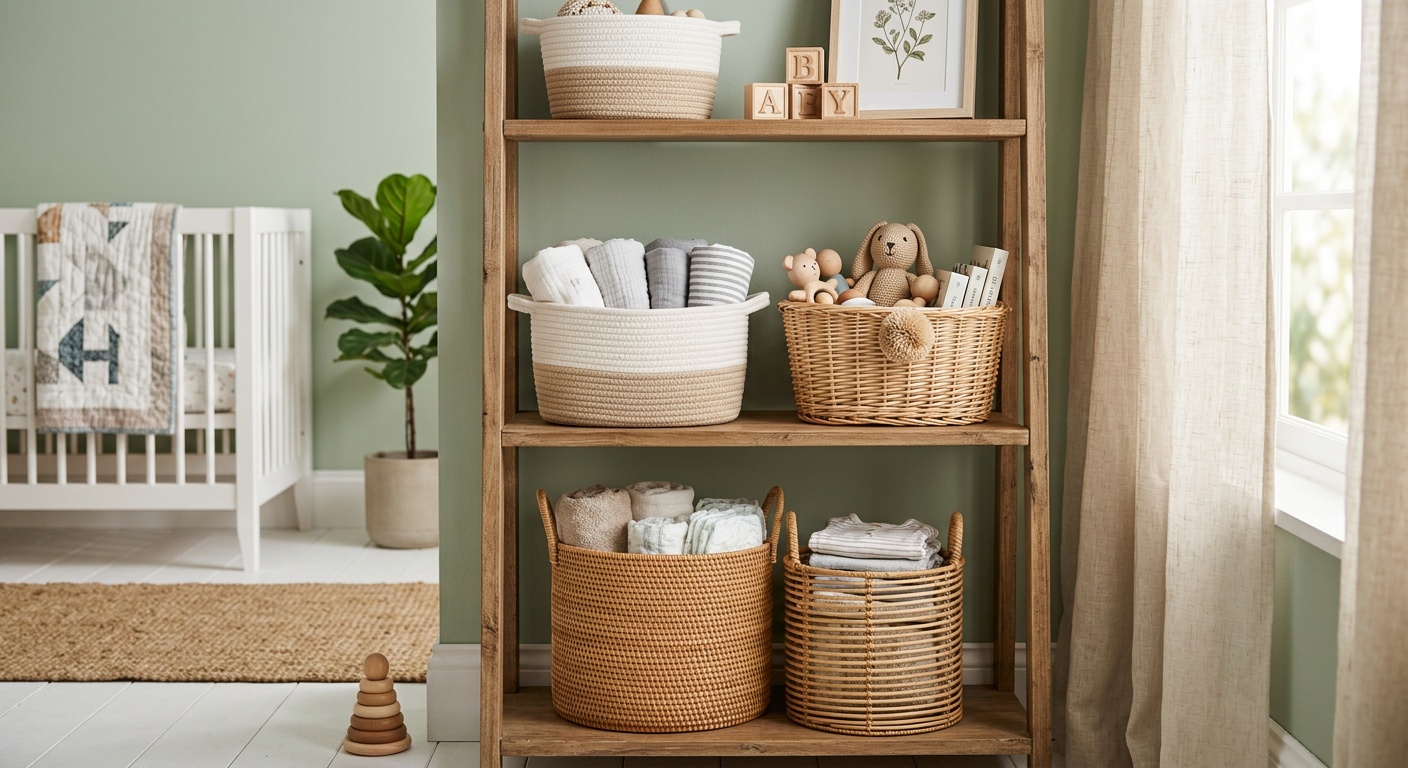
Here are the storage solutions that genuinely earn their place in a minimalist nursery:
- Vertical space utilization: Wall-mounted shelves keep the floor clear and make items visually accessible. In 2026, floating shelf systems with rounded edges designed specifically for nurseries have become a dominant choice — both safe and space-efficient.
- The one-in-one-out rule: Every time a new item enters the nursery, an existing item of equal size leaves. This prevents the natural accumulation that derails even the most organized spaces.
- Transparent or labeled containers: Opaque bins require opening to identify contents. Use clear containers or label everything with large, readable text. At 3 AM, ambiguity is the enemy.
- Under-crib storage: Low, flat rolling bins under the crib are excellent for storing extra sheets, seasonal items, or the next clothing size — keeping them accessible without consuming dresser space.
- Hanging closet organizers: Baby clothing is tiny; a standard closet rod wastes enormous vertical space. A hanging organizer with multiple rods or shelves can triple your closet capacity without adding furniture.
What to avoid: decorative baskets that look beautiful but function terribly (contents become a jumbled mess within 48 hours), oversized toy chests that become black holes, and multi-purpose “station” units that promise to do everything and end up doing nothing well.
Creating a Safe, Comfortable Environment
Organization isn’t just about where things go — it’s also about the environment you’re maintaining. A minimalist nursery philosophy extends to the air quality and temperature in the room, two factors that directly impact both baby’s sleep quality and health.
In 2026, with rising global temperatures affecting indoor comfort levels in previously temperate regions, parents are increasingly asking whether cooling solutions are appropriate for newborns. If you’re considering options for your baby’s room, it’s worth understanding is air cooler good for babies before making any decisions — the answer involves important nuances about airflow direction, humidity levels, and temperature ranges that vary by device type.
From an organization standpoint, here’s how to keep your environmental equipment from cluttering the nursery:
- Position cooling or air quality devices on raised surfaces rather than the floor, where they can be knocked over and where floor-level airflow is less beneficial.
- Manage cables intentionally. Cable clutter from monitors, sound machines, humidifiers, and charging stations is one of the biggest visual disorganizers in a nursery. Use cable ties, wall-mounted cable channels, or furniture with built-in cable management.
- Choose multi-function devices when genuinely useful. A combination humidifier and air purifier occupies one outlet and one surface space. A separate humidifier and separate purifier doubles the footprint and the visual noise.
- Keep the floor completely clear. This isn’t just aesthetics — it’s safety. A clear nursery floor means faster emergency response, safer nighttime navigation, and easier cleaning.
The ideal nursery temperature for newborns, according to the American Academy of Pediatrics in their 2025 updated guidelines, is between 68°F and 72°F (20°C–22°C). Maintaining this consistently, especially during 2026’s warmer summers, is a genuine health priority — and your organizational choices around equipment placement directly affect how effectively you maintain it.
Real Parent Scenarios: What Actually Worked
Theory is one thing. Let’s look at how this plays out in real nurseries.
Scenario 1: The Overwhelmed First-Time Mom in a Studio Apartment
Maya, a 32-year-old graphic designer in Chicago, welcomed her daughter in early 2025 with a combined living space of 620 square feet. The nursery corner — a 9×9 ft section of the main room — was initially packed with a full-size crib, a changing table, a glider, a dedicated toy storage unit, a dresser, and a swing that was used approximately four times before her daughter refused it.
After doing a ruthless audit using the three-question framework above, Maya reduced her nursery footprint dramatically: she replaced the full-size crib with a space-saving convertible crib, returned the dedicated toy unit (her daughter was three months old — she didn’t need it), sold the swing, and consolidated her changing supplies onto the top of the dresser with a foldable changing pad, eliminating the standalone changing table entirely.
The result? She recovered nearly 15 square feet of floor space, reduced her weekly tidying time from 40 minutes to under 10, and — her words — “stopped feeling like I was drowning every time I walked into the room.”
Scenario 2: The Organized Dad Who Over-Organized
James, a 38-year-old project manager, approached his son’s nursery like a logistics challenge. He purchased 27 separate labeled containers, installed a six-shelf closet system, and created a color-coded inventory system for baby supplies. By week three, none of the containers were being used correctly, the closet system had collapsed under the weight of items he’d bought speculatively, and the inventory system was abandoned entirely.
His pivot: he stripped everything back to five containers total (sleep supplies, diapering supplies, feeding supplies, clothing overflow, and future-stage items), installed one single adjustable wall shelf, and committed to the one-in-one-out rule. The nursery became functional overnight. The irony wasn’t lost on him: less organization infrastructure created a more organized space.
Minimalist vs. Traditional Nursery: A Data Overview
Based on 2025 parenting surveys and environmental psychology research, here’s how minimalist and traditionally-stocked nurseries compare across key wellbeing metrics:
Parent Satisfaction & Functionality Scores (Out of 100)
Green = Minimalist approach | Orange = Traditional approach. Source: Aggregated parenting satisfaction surveys, 2025.
Product Category Comparison: Essential vs. Non-Essential
| Product Category | Minimalist Verdict | Usage Frequency | Space Impact | Recommendation |
|---|---|---|---|---|
| Infant Swing / Bouncer | Non-Essential | Variable (50% unused) | High | Borrow or rent first |
| Dedicated Changing Table | Non-Essential | High but replaceable | High | Use dresser-top pad instead |
| Safe Sleep Surface (Crib/Bassinet) | Essential | Daily | High but necessary | Convertible crib for longevity |
| White Noise Machine | Essential | Daily | Low | Buy; compact models available |
| Toy Storage Unit | Non-Essential (early) | Low (0–6 months) | Medium-High | Introduce at 6+ months |
Frequently Asked Questions
How do I handle baby shower gifts without filling my minimalist nursery with things I don’t need?
This is genuinely one of the most common challenges new parents face in 2026. The most effective approach: create a specific registry focused entirely on essentials, and include a note or politely communicate to close family and friends that experiences, consumables (diapers, wipes), or gift cards are preferred over physical items. For gifts that arrive anyway, practice the “30-day hold” — store unopened items and reassess whether they’re genuinely needed after a month. Return or donate what doesn’t earn its place. Gratitude and functionality are not mutually exclusive.
What’s the most common minimalist nursery mistake new parents make?
Confusing visual minimalism with functional minimalism. Many parents create a beautiful, sparse-looking nursery but store massive quantities of items in hidden storage that are never actually used. True minimalist organization means reducing the total quantity of items, not just hiding the excess. A clean aesthetic backed by overflowing, disorganized closets defeats the entire purpose. Start with subtraction, then arrange what remains — in that order.
How do I adapt a minimalist nursery as my baby grows without starting from scratch?
The key is building an adaptable framework from the start. Choose furniture that grows with your child: convertible cribs that become toddler beds, dressers that work for all ages, and modular shelving. For storage, rotate rather than accumulate — when your baby outgrows a developmental stage, physically remove those items (donate, store, or sell) before introducing the next stage’s items. A quarterly nursery audit takes under 20 minutes and prevents the gradual drift back toward clutter that happens in almost every home without deliberate maintenance.
Your Minimalist Nursery Blueprint: Next Steps
You now have a complete framework. The question isn’t whether a minimalist nursery works — the research, the real parent stories, and the functional logic all point clearly in one direction. The question is where you start.
Here’s your immediate action roadmap:
- This week: Do the honest audit. Walk through your nursery (or planned nursery) with the three-question framework and identify every item that can’t pass all three tests. Don’t remove anything yet — just list it.
- Next 48 hours after the audit: Physically remove or relocate items that failed the audit. Don’t negotiate. Store them elsewhere if you can’t commit to donating yet, but get them out of the nursery.
- Day 3-5: Establish your four zones. Even if your nursery is small, designate clear areas for sleeping, diapering, feeding, and storage. Label if helpful. Communicate the system to your partner or co-parent.
- Week 2: Implement one intentional storage solution — not a shopping trip, but a reorganization of what you already have using the principles in this guide.
- Monthly thereafter: Schedule a 15-minute nursery review. One item in, one item out. This is the habit that preserves everything you’ve built.
As children’s spaces evolve alongside broader trends toward intentional living and conscious consumption in 2026, the minimalist nursery philosophy is increasingly recognized not as a design preference but as a parenting wellness tool. The cleaner the space, the clearer the headspace — and in those first exhausting, extraordinary months, that’s not a luxury. It’s a lifeline.
Here’s the question worth sitting with: If you removed everything from your nursery that you’ve never used or rarely reach for, what would remain — and would that be enough to care for your baby beautifully? For most parents who actually try it, the answer is a resounding yes.
The nursery your baby needs is simpler than the one you’ve been told to build. Start there.
Article reviewed by Nina Svensson, Interior Architecture & Color Design Consultant, on June 8, 2026