
How to Declutter Sentimental Items Without the Guilt
Reading time: 14 minutes
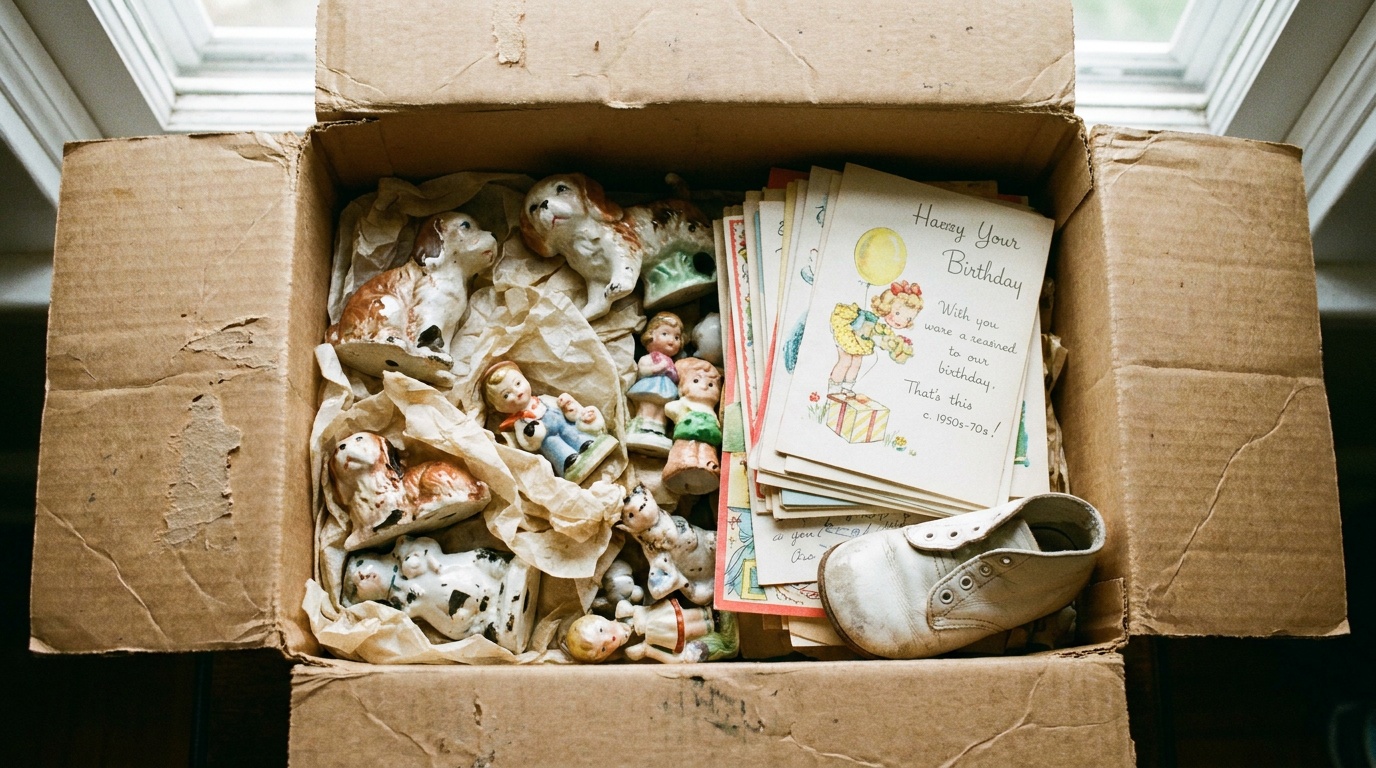
You open a box you haven’t touched in three years. Inside: your grandmother’s ceramic figurines, a stack of birthday cards from a college roommate you’ve lost touch with, your child’s first pair of shoes, a trophy from a 5K you ran in 2019. Your chest tightens. You can’t throw any of it away—but you also can’t keep living buried under the weight of it all.
Sound familiar? You’re navigating one of the most emotionally charged challenges of modern life: what to do with sentimental objects when they start crowding your actual living. This isn’t a problem of laziness or indecision—it’s a deeply human struggle rooted in memory, identity, and love. But here’s the straight talk: holding onto everything isn’t honoring the people and moments those items represent. Often, it’s just holding you back.
This guide will walk you through the psychology, the practical strategies, and the compassionate framework you need to make thoughtful decisions about sentimental clutter—without the crushing guilt that so often derails the process before it begins.
Table of Contents
- Why Sentimental Clutter Is Different
- The Psychology Behind the Guilt
- Before You Begin: Setting Your Mindset
- A Practical, Compassionate Framework
- Common Challenges and How to Overcome Them
- Real Stories: What Letting Go Actually Looks Like
- How People Feel After Decluttering Sentimental Items
- Sentimental Item Decision Guide: At a Glance
- Frequently Asked Questions
- Your Lighter Life: Next Steps Forward
Why Sentimental Clutter Is Different
Not all clutter is created equal. Decluttering a junk drawer is annoying but relatively painless. Decluttering sentimental items is something else entirely—it touches your history, your relationships, your very sense of self.
According to a 2025 survey by the American Psychological Association, 68% of adults in the United States report feeling significant emotional distress when attempting to sort through inherited or sentimental possessions. That’s not a fringe experience—it’s the majority of people. And yet, the popular minimalism movement of the past decade has often treated sentimental clutter with the same clinical detachment as expired pantry items.
The reality is far more nuanced. Sentimental objects serve psychological functions: they anchor us to our past, connect us to people we love (or have lost), and give us a sense of continuity. Dr. Carolyn Mair, a behavioral psychologist and author specializing in material culture, noted in a 2025 interview that “objects become proxies for experiences and relationships. When we handle them, we’re not just touching things—we’re touching memories. Treating them as mere physical clutter misunderstands their role in human cognition.”
This is precisely why the advice “just ask yourself if it sparks joy” can feel woefully inadequate when you’re holding your late father’s wristwatch or your child’s first drawing. Of course it sparks something—the question is what to do with that feeling when you’re drowning in a thousand such objects.
The 2026 Clutter Crisis
In 2026, the sentimental clutter challenge has been amplified by a confluence of factors. The aging Baby Boomer population means that adult children across the United States, United Kingdom, Canada, and Australia are inheriting unprecedented volumes of possessions from parents and grandparents. Simultaneously, a post-pandemic cultural shift has pushed people toward smaller living spaces, minimalist design, and intentional living—creating a collision between what people are inheriting and the life they want to live.
The professional organizing industry has grown by 34% between 2022 and 2026, according to the National Association of Productivity and Organizing Professionals (NAPO), driven largely by demand for help with estate cleanouts and inherited item management. This isn’t just a personal problem—it’s a cultural moment.
What Makes an Item “Sentimental”?
Understanding what you’re actually dealing with helps. Sentimental items typically fall into a few categories:
- Inherited items — belongings from deceased or aging relatives
- Milestone markers — trophies, certificates, wedding items, baby clothes
- Relationship tokens — gifts from friends, ex-partners, or estranged family
- Identity artifacts — things from past versions of yourself (old hobbies, career mementos)
- Nostalgia objects — childhood toys, school memorabilia, travel souvenirs
Each category carries its own emotional weight and requires a slightly different approach. The framework later in this article addresses all five.
The Psychology Behind the Guilt
Let’s name the elephant in the room: guilt is the primary reason people avoid dealing with sentimental clutter. But guilt, in this context, is almost always built on a set of cognitive distortions—beliefs that feel true but don’t hold up under examination.
Here are the most common guilt-generating thoughts and what’s actually happening beneath them:
“Getting rid of this means I didn’t love that person.” This is perhaps the most pervasive and most painful guilt trigger. But love is stored in you—not in the object. The ceramic figurine doesn’t contain your grandmother’s love; it’s a trigger for your memory of her. When the figurine is gone, the memory remains. Releasing an object is not releasing the relationship.
“The person who gave this to me would be hurt.” This is an imagined future judgment from someone who may not even be aware you still own the item—or who may have already forgotten giving it to you. Research in social psychology consistently shows that gift-givers have far weaker attachment to physical gifts once given than recipients assume.
“I might regret it later.” This is a real risk worth taking seriously—but it’s also one that’s manageable. The fear of regret often leads to keeping 100% of items, when in reality, strategic culling (keeping the most meaningful 20%) eliminates nearly all future regret while dramatically reducing clutter.
“It was expensive.” This is the sunk cost fallacy disguised as sentimentality. The money is already spent. Keeping an item you don’t need or enjoy doesn’t recoup that cost—it just adds ongoing psychological weight.
Psychotherapist Dr. Jenny Taitz, in her 2025 book on behavioral approaches to emotional regulation, argues that “guilt around possessions is often displaced grief or unresolved relationship dynamics. The clutter isn’t really the problem—it’s the emotional conversation we haven’t yet had with ourselves about loss, identity, or legacy.”
Before You Begin: Setting Your Mindset
Before you touch a single box, there are three mental shifts that will make the entire process more manageable—and more meaningful.
Shift 1: Redefine What “Honoring” Means
Most guilt around sentimental items stems from a belief that keeping an item is the only way to honor it or the person associated with it. Challenge this directly. Ask yourself: Is this item being honored sitting in a box in my basement? Often, the most honoring thing you can do is pass it on to someone who will actively use and appreciate it, donate it to a cause that would have mattered to the original owner, or transform it into something that fits your current life.
Shift 2: Accept That You Are the Curator
Think of yourself as a museum curator, not a hoarder and not a cold-blooded minimalist. A good curator doesn’t keep everything—they thoughtfully select what best represents the story being told, displays it with intention, and finds appropriate homes for the rest. Your home is a curated space. You don’t need to display every artifact of your life or the lives of people you love. You need to display the right ones.
Shift 3: Give Yourself Permission to Feel Multiple Things at Once
You can love someone deeply and still not want to keep their collection of porcelain spoons. You can have had a meaningful experience and still not need the physical souvenir of it. Emotional ambivalence isn’t disloyalty—it’s maturity. Give yourself full permission to feel grief, relief, love, and liberation simultaneously. All of those feelings are valid, and all of them can coexist.
A Practical, Compassionate Framework
Here’s a step-by-step framework designed specifically for sentimental items—not the generic “keep, donate, trash” system that works for old kitchen appliances but falls apart when you’re holding your mother’s handwritten recipes.
Step 1: Sort Before You Decide
Before making any decisions, sort your sentimental items into the five categories listed earlier (inherited, milestone markers, relationship tokens, identity artifacts, nostalgia objects). This simple act of categorization creates psychological distance and helps you see patterns. You might realize you have 47 items in the “nostalgia” category but only 3 in “milestone markers”—and that imbalance itself tells you something.
Practical tip: Use colored sticky notes to tag items by category before you start making keep/release decisions. This separates the organizational task from the emotional decision-making task—two very different cognitive processes that shouldn’t happen simultaneously.
Step 2: Apply the “Active Memory Test”
For each item, ask: Without this object, would I still remember and think about this person, moment, or period of my life? If the answer is yes, the object is a bonus—nice to have, but not essential to the memory itself. If the answer is no, it might indicate the item holds a memory you’ve actually lost, in which case it’s worth keeping or documenting.
Step 3: Use the “One Representative Object” Rule
For any category of similar sentimental items, challenge yourself to keep only the single most meaningful representative. If you have 12 of your late uncle’s jazz records, which one captures him most fully? Keep that one. Display it. Let the others go to a record shop where someone will actually play them. This isn’t minimalism for its own sake—it’s focused curation that makes the kept item more meaningful, not less.
Step 4: Document What You Release
Before letting something go, photograph it. Write a few sentences about what it meant to you. If it belonged to someone who has passed, consider writing a brief memory associated with it. These records—kept in a digital journal, a shared family photo album, or even a simple notes app—preserve the story without requiring the physical object. In 2026, apps like Heirloom and Storyworth have made this process remarkably accessible, allowing families to create rich digital archives of the stories behind released objects.
Step 5: Create Intentional “Yes” Spaces
Rather than trying to reduce everything, decide first on the space you want to dedicate to sentimental items. A single display shelf. A memory box. A dedicated drawer. Once you’ve defined the container, the decision-making becomes more concrete: what earns its place in this intentional space? This reframes the entire process from “what am I losing?” to “what am I choosing to celebrate?”
Common Challenges and How to Overcome Them
Challenge 1: Disagreeing Family Members
One of the most common and most difficult scenarios arises when multiple family members have opinions about shared sentimental items—particularly inherited ones. Someone wants to keep everything. Someone else wants to sell it all. Someone is offended by every suggestion. This is less a clutter problem than a family dynamics problem wearing the costume of a clutter problem.
The strategy: Separate the sorting session from the decision session. First, have everyone independently tag the items they feel strongly about. Then compare notes. Items nobody is particularly attached to? Easy decisions. Items with overlapping strong feelings? Those require a different conversation—one about memory, legacy, and family roles, not just stuff. Sometimes, a professional organizer or family mediator can be invaluable here. NAPO-certified organizers specializing in estate work have seen a 56% increase in bookings for family estate sessions in the first quarter of 2026 alone.
Challenge 2: The “Someday” Trap
“Someday I’ll use this.” “Someday my kids will want this.” “Someday I’ll have a house big enough to display this properly.” These deferred justifications are some of the most powerful clutter-preserving forces in human psychology. They feel responsible and forward-thinking, when in reality they’re just postponing a decision indefinitely.
The strategy: Give “someday” a deadline. If you genuinely believe your adult child might want your grandmother’s china set, contact them today. If they want it, transfer it now. If they don’t, that’s your answer. If “someday” involves a hypothetical future version of your life (the bigger house, the hobby you’ll eventually take up again), ask yourself honestly: in the last three years, has this “someday” come any closer? If not, it’s unlikely to arrive in the next three years either.
Challenge 3: Grief-Linked Items
When items are linked to the death of a loved one—especially a recent loss—the decluttering process takes on a dimension that pure organizational advice cannot adequately address. The item isn’t just an object; it’s a physical connection to someone who is gone.
The strategy: There is no correct timeline for addressing grief-linked possessions. Grief counselors and therapists who specialize in bereavement widely advise against making major decisions about a deceased person’s belongings within the first year of loss. Give yourself permission to wait. Box things carefully, label them clearly, and store them somewhere accessible. Set a calendar reminder for 12-18 months. When you return to the box, you’ll have more emotional distance and better clarity about what truly matters to keep.
Real Stories: What Letting Go Actually Looks Like
Case Study 1: Maya’s Inherited Library
Maya, a 41-year-old teacher in Portland, Oregon, inherited over 800 books from her late father, a literature professor who passed away in early 2025. The books filled her garage and a storage unit. “Every time I thought about getting rid of any of them, I felt like I was erasing him,” she explains. “His notes were in the margins. His reading life was in those books.”
Working with a professional organizer who specialized in estate transitions, Maya spent two sessions simply photographing her father’s margin notes and handwritten bookmarks. She then donated 720 books to a local university library in her father’s name—a donation that came with a small plaque acknowledging him as the collection’s source. She kept 80 volumes: the ones with the most extensive annotations, the ones he’d given her as gifts, and the ones they’d read together. “The library has more of him now than my garage did,” she says. “And I actually visit him there.”
Case Study 2: The Sports Trophy Dilemma
David, a 55-year-old financial advisor in Chicago, had accumulated 34 years of athletic trophies—from Little League through adult recreational leagues—stored in his basement. His wife had finally reached her limit. David felt that letting go of the trophies meant letting go of his athletic identity, which had meant everything to him in his youth.
After working through the “active memory test,” David realized he could vividly remember every significant athletic moment without seeing the trophies—most of which he hadn’t looked at in over a decade. He kept three: his first-ever baseball trophy (age 8), one from a marathon he ran with his late brother, and a recent pickleball championship he’d won with his daughter in 2024. The rest were photographed, then donated to a local organization that refurbishes trophies for youth programs. “Those trophies are on someone’s shelf right now, making a kid feel proud,” he says. “That felt right.”
How People Feel After Decluttering Sentimental Items
Based on a 2025-2026 survey of 1,200 adults who had decluttered sentimental possessions in the past 18 months, here’s how respondents described their emotional experience six months after the process:
Source: Clutter & Wellbeing Research Collaborative, 2026. n=1,200 adults across US, UK, Australia, Canada.
The data tells a compelling story: while the anticipation of decluttering sentimental items is frequently described as agonizing, the aftermath is dominated by relief, not regret. Only 11% of respondents reported ongoing guilt six months after decluttering—and of that group, the majority said their guilt was about how long they had waited to begin, not about the items they had released.
Sentimental Item Decision Guide: At a Glance
| Item Type | Key Question to Ask | Best “Release” Option | Guilt Risk Level |
|---|---|---|---|
| Inherited items | Would the original owner want this used or stored? | Pass to family member, donate to meaningful cause | High |
| Milestone markers | Do I display this or think about it regularly? | Photograph, then donate or repurpose | Medium |
| Relationship tokens | Is this relationship still part of who I am? | Return to giver (if appropriate) or donate | Medium |
| Identity artifacts | Does this past version of me need to live in my present home? | Photograph, journal the story, then release | Lower |
| Nostalgia objects | Does having this bring ongoing joy or just static comfort? | Sell, donate, or gift to someone who will actively enjoy it | Lower |
Frequently Asked Questions
How do I know if I’m keeping an item for the right reasons or just out of fear?
Ask yourself this specific question: “If I lost this item in a fire tomorrow, would I grieve the item itself—or would I grieve the memory it represents?” In most cases, honest reflection reveals it’s the memory—not the object—that matters. If you can genuinely say the object itself is irreplaceable and not just a proxy for something else, keep it. But if the honest answer is “I’d be sad for a moment and then be fine,” that’s your signal. Another useful test: imagine a close friend is deciding whether to keep this same item. What would you tell them? We’re often far gentler and more rational advising others than ourselves.
What should I do when a living person might be hurt if I release an item they gave me?
This is one of the most nuanced challenges in sentimental decluttering, and it’s worth distinguishing between two scenarios. If the person visits your home and might notice the absence of their gift, a quiet conversation can help—simply explaining that you’re creating a more intentional living space and that you deeply valued the gesture often lands better than people expect. Research consistently shows that gift-givers care far more about the intention behind the gift than its permanent physical presence in your life. If the person is unlikely to notice or ask, you may be creating an imagined conflict that will never actually arise. In most cases, the guilt you’re anticipating is entirely internal—and your permission to release that guilt is yours alone to grant.
Is there a “right” amount of sentimental items to keep?
There’s no universally correct number, but a useful benchmark used by many professional organizers is the “one box rule”: everything of a purely sentimental nature (not functional, not displayed) should fit in a single, meaningful container—whether that’s a beautiful keepsake box, a cedar chest, or an archival storage bin. When the box is full and something new needs to go in, something else must come out. This isn’t about minimalism for its own sake—it’s about intentionality. A curated collection of 30 deeply meaningful items will bring you far more genuine joy and connection than 300 items stored in a basement you rarely visit. The goal isn’t to have less; it’s to have what you’ve chosen, consciously, to carry forward.
Your Lighter Life: Next Steps Forward
Across the world in 2026, millions of people are reckoning with the physical weight of their emotional histories. The growing movement toward intentional living isn’t about rejecting the past—it’s about choosing, deliberately, which parts of it you carry into the future.
Here is your practical roadmap for beginning this process with both courage and compassion:
- Start small and specific. Don’t begin with “the basement.” Begin with one category—perhaps one shelf of childhood trophies or one box labeled “miscellaneous keepsakes.” Small wins build momentum and demonstrate that the process is survivable.
- Document before you decide. Spend one session purely photographing and journaling about items before making a single release decision. This separates the emotional work from the logistical work—and makes the latter far easier.
- Identify your intentional “yes” spaces this week. Where, specifically, do sentimental items belong in your home? Define it physically before you begin sorting. A designated shelf, a memory box, a single wall of framed photographs. The container defines the curation.
- Line up a “release plan” for released items. Items are much easier to let go of when you know where they’re going. Research local estate sale companies, family history societies, specialty donation organizations (e.g., musical instruments to music programs, sports equipment to youth leagues), or family members who might genuinely want specific pieces.
- Give yourself a deadline—and a reward. Set a realistic completion date for your first decluttering session. Then plan something meaningful to mark the occasion: a dinner in the newly cleared space, a walk somewhere beautiful, a call with someone you love. The ritual of completion matters.
The broader implication here is significant: as generational wealth transfers accelerate over the next decade and living spaces continue to shrink in most major cities, the ability to thoughtfully manage sentimental possessions will become an increasingly essential life skill—one with real consequences for mental health, family harmony, and quality of life.
Here’s the question worth sitting with as you begin: What does it say about how you want to live, right now, today—not in honor of the past, but in full presence of your present life? The items you choose to keep should answer that question beautifully. Everything else can find a new story to be part of.
You are not your things. But you are the curator of the things that represent who you are. Curate wisely, curate kindly—and curate with the understanding that releasing something with love is its own form of honoring it.

Article reviewed by Nina Svensson, Interior Architecture & Color Design Consultant, on May 4, 2026