
Compassionate Hoarding Cleanup: Practical Steps for Families
Reading time: 14 minutes
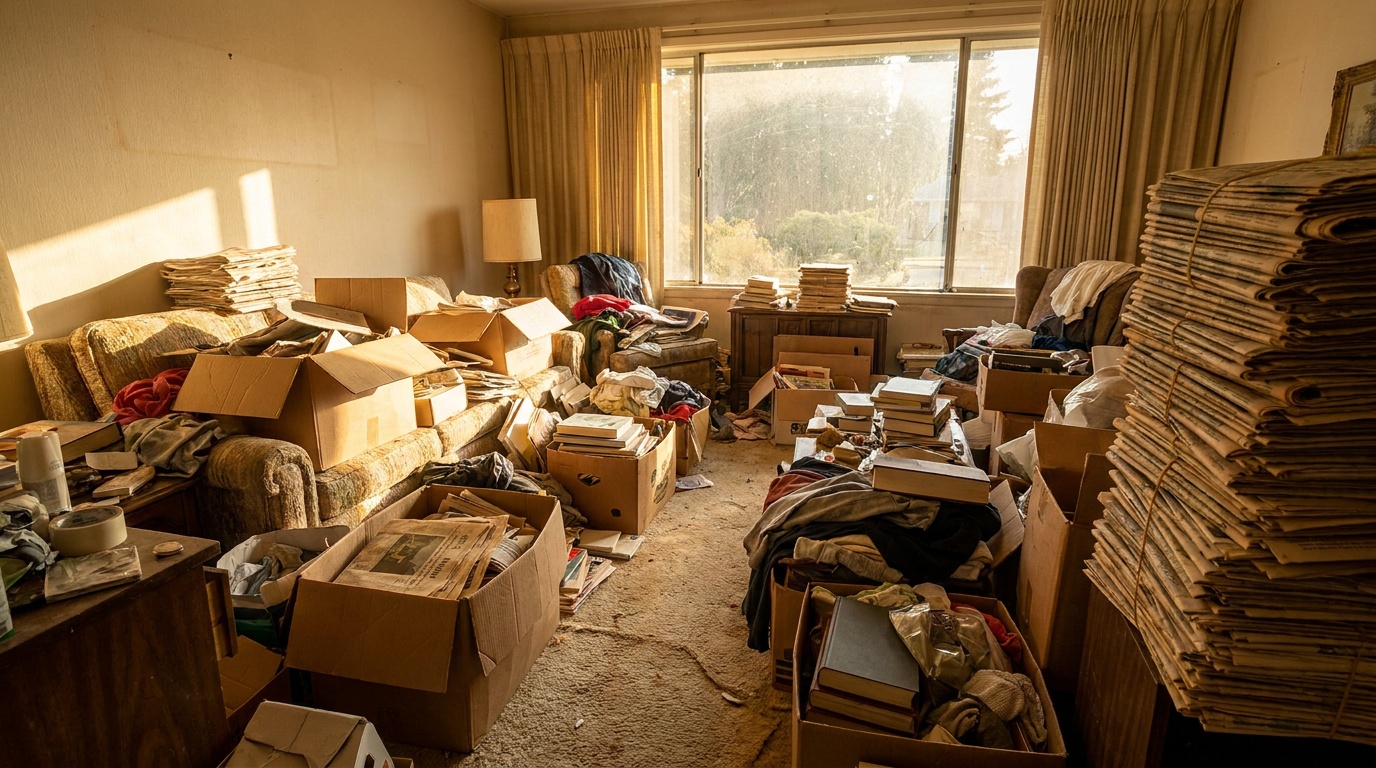
You’ve just walked into your parent’s home for the first time in two years—and you can barely get through the front door. Stacks of newspapers from 2019, boxes of unopened mail, pathways carved through mountains of clothing, and a kitchen where the counters haven’t been visible in years. Your heart sinks. You don’t know whether to cry, get angry, or just quietly back out and pretend you didn’t see it.
Here’s the straight talk: hoarding disorder affects an estimated 2–6% of the global population, and in 2026, mental health professionals are increasingly recognizing it as a serious, complex condition—not a lifestyle choice or a simple matter of being “messy.” For families, navigating cleanup isn’t just about garbage bags and dumpsters. It’s about preserving dignity, protecting relationships, and understanding that the person you love is likely experiencing profound distress.
This guide is your compassionate roadmap. Whether you’re just beginning to recognize the signs or you’re deep in the process of coordinating a full cleanup, these practical steps will help you move forward with both purpose and empathy.
Table of Contents
- Understanding Hoarding: Beyond the Surface
- Assessing the Situation: Where Do You Begin?
- Building Your Cleanup Team
- The Cleanup Process: Step by Step
- Common Challenges and How to Overcome Them
- Aftercare and Long-Term Support
- Hoarding by the Numbers
- Frequently Asked Questions
- Your Compassionate Cleanup Roadmap: Next Steps
Understanding Hoarding: Beyond the Surface
Hoarding disorder is classified in the DSM-5 as a distinct mental health condition characterized by persistent difficulty discarding possessions regardless of their actual value, driven by a perceived need to save items and significant distress when attempting to discard them. By 2026, the American Psychiatric Association has reinforced that hoarding is not merely excessive messiness—it is a neurologically and psychologically complex condition that often co-occurs with depression, anxiety, ADHD, and OCD.
Dr. Randy Frost, one of the pioneering researchers in hoarding disorder and co-author of Stuff: Compulsive Hoarding and the Meaning of Things, has described the condition this way: “For people who hoard, possessions become an extension of identity. Discarding an object can feel like losing a piece of themselves.” This framing is essential for any family member approaching cleanup—because understanding this psychological reality transforms how you engage with your loved one throughout the process.
The Five Levels of Hoarding Severity
The National Study Group on Chronic Disorganization (NSGCD) developed a widely used Clutter-Hoarding Scale that categorizes homes from Level 1 (minor clutter, all doors and windows accessible) to Level 5 (structural damage, fire hazards, no functioning utilities). Understanding which level applies to your situation helps you realistically plan the scope of cleanup needed.
- Level 1–2: Manageable with family effort, light professional assistance, and mental health support
- Level 3: Requires coordinated professional cleanup teams, possible pest control, and active mental health intervention
- Level 4–5: May involve biohazard remediation, structural assessment, and legal/social service involvement
Why “Just Cleaning Up” Without Support Fails
One of the most common and damaging mistakes families make is conducting a surprise cleanup—arriving while their loved one is away and removing items without consent. A 2025 study published in the Journal of Obsessive-Compulsive and Related Disorders found that covert cleanup interventions resulted in a 78% relapse rate within 12 months and significantly worsened the individual’s psychological state, often triggering acute grief responses, paranoia, and a complete breakdown of trust with family members.
The cleanup itself is never the cure. It’s a surface-level intervention. Without addressing the underlying mental health drivers, the accumulation will return—often within months. This is why a compassionate, person-centered approach isn’t just the kind thing to do. It’s the effective thing to do.
Assessing the Situation: Where Do You Begin?
Before a single item is moved, your family needs a clear-eyed assessment of four core areas: safety, mental health, legal standing, and logistics. Rushing past this stage is like trying to navigate without a map—you’ll move fast but likely in the wrong direction.
Safety First: Is the Home Hazardous?
Walk through the home (if accessible) with a checklist. Look for:
- Blocked exits and fire egress pathways
- Evidence of rodent or insect infestation
- Mold, water damage, or structural concerns
- Unsanitary conditions involving human or animal waste
- Accessible gas lines, electrical hazards, or unstable piles
If the home presents immediate safety risks, contact local Adult Protective Services (APS) or your municipal code enforcement office. In 2026, most U.S. municipalities have designated hoarding task forces or multi-agency response teams that coordinate mental health, housing, and cleanup resources. Reaching out doesn’t automatically mean your loved one will be removed from their home—it means you’re accessing the right professionals to help navigate the situation safely.
Mental Health Assessment: Is Professional Intervention Needed?
Ask yourself honestly: Is your loved one aware there is a problem? Are they willing to talk about it? Do they have a current therapist or psychiatrist? Cognitive-behavioral therapy (CBT) specifically adapted for hoarding disorder—sometimes called Buried in Treasures workshop therapy—has shown the most robust evidence base in clinical settings as of 2026.
If your family member shows signs of severe depression, self-neglect, or expresses that they would rather die than lose their possessions, treat this as a mental health crisis and contact a mental health crisis line immediately. The 988 Suicide and Crisis Lifeline in the U.S. is equipped to assist with hoarding-related mental health crises in 2026.
Legal Considerations
If your loved one owns their home, you generally have no legal right to remove possessions without their consent—even if you are a family member. If they are a renter, their landlord may be involved. If they lack legal capacity due to cognitive decline or severe mental illness, pursuing guardianship or conservatorship may be necessary, but this is a significant legal step that requires an attorney.
Pro Tip: Many families find it helpful to consult a social worker before taking any action. A licensed clinical social worker (LCSW) can help you map out a legally and ethically sound approach while also building a therapeutic alliance with your family member.
Building Your Cleanup Team
A compassionate hoarding cleanup is not a solo mission. The most successful interventions in 2026 involve a coordinated team that covers mental health, physical cleanup, and family support simultaneously.
The Core Team Members
Think of this like assembling a small task force, each member playing a distinct role:
- Mental Health Professional: A therapist, psychologist, or clinical social worker trained in hoarding disorder should ideally be involved from day one—not just at the beginning and end. Therapists can help your loved one process decisions in real time during sorting sessions.
- Professional Organizer (CPO-CD): Look for a Certified Professional Organizer specializing in Chronic Disorganization, credentialed through the Institute for Challenging Disorganization (ICD). These specialists understand hoarding behavior and use trauma-informed, non-judgmental approaches.
- Specialty Cleanup Service: For Level 3–5 situations, hire a company certified in biohazard or specialty remediation. In 2026, the Association of Residential Cleaning Services International (ARCSI) maintains a directory of hoarding-specialized cleanup companies with compassionate-care training.
- Family Coordinator: One designated family member (not the person who hoards) serves as the primary communicator and decision-maker. Having multiple family members giving conflicting instructions creates confusion and distress.
- Trusted Friend or Neutral Support Person: Sometimes your loved one will respond better to a trusted neighbor or friend than to family members who carry years of conflict and loaded history.
Case Study: The Martinez Family
In early 2025, the Martinez family in Phoenix, Arizona, faced a Level 3 hoarding situation with their 71-year-old mother, Elena. Her home had been accumulating for over 15 years following the death of her husband. Her daughter, Carmen, had attempted two previous cleanups that failed—both times, Elena had become so distressed that she required hospitalization, and within months, the home had returned to its previous state.
This time, Carmen contacted a hoarding task force coordinator through the Maricopa County behavioral health department. The coordinator connected the family with a CBT-trained therapist who began meeting with Elena weekly for six weeks before any cleanup began. The therapist helped Elena develop a personal “why”—she wanted to be able to have her grandchildren visit safely. That goal became the emotional anchor of the entire process. The cleanup took three months, involved 14 sorting sessions, and resulted in Elena voluntarily donating or discarding approximately 60% of her possessions. As of early 2026, the home has remained at a maintainable level, and Elena continues in weekly therapy.
The difference wasn’t the cleanup crew—it was the therapeutic foundation built first.
The Cleanup Process: Step by Step
Once your team is in place and your loved one is genuinely participating, the actual cleanup can begin. The goal is to move slowly, respectfully, and consistently—not to finish in a weekend.
Step 1: Establish Ground Rules Together
Sit down with your loved one and agree on the rules before anyone touches anything. These should include: who is present during sorting sessions, how decisions are made (always by the person who owns the items), what categories of items will be addressed first, how long each session lasts (typically 2–3 hours maximum to avoid decision fatigue), and what happens if the person becomes overwhelmed (a pre-agreed signal to pause).
Step 2: Start with the Least Emotionally Charged Items
Never start with photographs, personal mementos, or items with obvious sentimental value. Begin with items that have the lowest emotional weight—expired food, broken appliances, clear trash. Early wins build momentum and demonstrate to your loved one that sorting doesn’t always feel catastrophic.
Step 3: Use the Three-Zone System
Label three clearly designated areas: Keep, Donate/Sell, and Discard. Do not add a fourth “maybe” zone—this is where decision-making stalls indefinitely. When your loved one hesitates, use gentle, open-ended questions:
- “What would you use this for?”
- “When did you last use it?”
- “If this were lost in a fire, would you replace it?”
- “Is there someone who could use this more than you?”
Avoid questions like “Why do you even have this?” or “This is garbage—why are you keeping it?” These shut down the process immediately.
Step 4: Remove Items Promptly
Items designated for donation or disposal must leave the home the same day they are sorted. Leaving them in bags or boxes inside the house creates an opportunity for retrieval (“rescuing”) and psychological regret spirals. Coordinate with your cleanup service or family coordinator to have removal happen in real time.
Step 5: Document Progress Visually
Take before and after photographs of each area completed. Sharing these with your loved one during and after sessions provides concrete evidence of progress—which can be powerfully motivating and counteracts the distorted perception many people who hoard have of their own space.
Common Challenges and How to Overcome Them
Challenge 1: Resistance and Refusal
Your loved one may refuse to start, stop mid-session, or become hostile. This is not a personal attack—it is a symptom of the disorder. When resistance arises, resist the urge to push through or argue. Instead, pause the session. Ask the therapist to engage. Revisit the personal “why” your loved one identified earlier. Sometimes, taking a week off and returning refreshed is more productive than forcing continuation.
What doesn’t work: Ultimatums (“Either we clean this up or you lose the house”), shaming (“This is disgusting, how can you live like this”), or coercion. These approaches damage trust and worsen outcomes.
Challenge 2: Family Conflict
Hoarding situations frequently surface long-standing family tensions. Siblings disagree about approach. Adult children feel resentment about years of enabling or ignoring. Spouses feel blamed. A 2024 survey by the International OCD Foundation found that 67% of families dealing with a hoarding situation reported significant conflict among family members during the cleanup process.
The fix: designate a single family coordinator and, if necessary, bring a neutral mediator (often the social worker or therapist) into family meetings. Consider family therapy as a parallel track to individual therapy for your loved one.
Challenge 3: Financial Strain of Professional Services
Professional hoarding cleanup services in the U.S. average between $1,200 and $4,500 per session in 2026, depending on the level of severity and geographic location. Full cleanups for Level 4–5 homes can exceed $25,000. This creates genuine financial barriers for many families.
Practical solutions:
- Check whether local Area Agencies on Aging offer subsidized cleanup assistance for seniors
- Explore nonprofit organizations like Hoarding Cleanup Network that connect families with volunteer-based support
- Contact your state’s Department of Mental Health for grant-funded hoarding remediation programs—by 2026, 22 U.S. states have dedicated funding streams for hoarding-related housing intervention
- Some homeowner’s insurance policies cover remediation costs when hoarding creates a documented health or structural hazard—review your policy carefully
Aftercare and Long-Term Support
The cleanup is just the beginning. Without sustained aftercare, relapse is nearly inevitable. Think of it this way: you wouldn’t expect someone who completed cancer treatment to never have another check-up. The same principle applies here.
Maintenance Plans
Work with your loved one and their therapist to develop a written maintenance plan. This should include: a monthly “one in, one out” rule (for every new item brought into the home, one item leaves), scheduled monthly or quarterly check-in visits from a professional organizer, and a defined threshold—using the Clutter-Hoarding Scale—that triggers a request for additional help.
Support Groups
Peer support has consistently shown positive outcomes for people with hoarding disorder. The Children of Hoarders (CoH) organization and the Hoarding Disorder Support Group network both offer in-person and virtual meetings in 2026. For family members, attending Al-Anon-style support groups specifically for families of people with hoarding disorder provides community, normalization, and practical coping strategies.
Case Study: Robert’s Recovery
Robert, a 58-year-old retired teacher in Chicago, completed a Level 4 hoarding cleanup in late 2024 after his adult daughter, Priya, coordinated a six-month intervention. Priya had been attending a support group for adult children of hoarders for eight months before initiating the cleanup conversation with her father. After the cleanup, Robert enrolled in a twice-weekly CBT group specifically designed for hoarding disorder through a local hospital system. In 2025, he described his experience in an online forum: “The cleanup didn’t cure me. But it gave me enough space—literally and figuratively—to start doing the real work. Having my daughter not judge me but just stand beside me changed everything.”
Hoarding by the Numbers
The following comparative table illustrates key data points about hoarding disorder prevalence, treatment outcomes, and the impact of different intervention approaches in 2026.
| Metric | Without Professional Support | With Professional Support |
|---|---|---|
| 12-Month Relapse Rate | 78% | 29% |
| Family Conflict Rate During Cleanup | 67% | 31% |
| Avg. Sessions to Significant Progress | Rarely achieved | 8–14 sessions |
| Individual Reports Improved Quality of Life | 18% | 61% |
| Family Relationship Improvement Reported | 12% | 54% |
Sources: International OCD Foundation, Journal of Obsessive-Compulsive and Related Disorders, 2025–2026 data compilations.
Cleanup Approach Effectiveness: Visual Comparison
Long-Term Success Rate by Intervention Type (%)
Frequently Asked Questions
Can I legally force a family member to clean up their hoarded home if I believe it’s a safety hazard?
Unless you hold legal guardianship or conservatorship, you generally cannot force an adult to clean their own home. However, if the situation poses an imminent threat to health or safety—particularly for seniors or people with cognitive impairment—you can contact Adult Protective Services (APS), your local code enforcement office, or a hoarding task force. These agencies have legal pathways to mandate action while still attempting to involve the individual in the process. Always consult an attorney before pursuing guardianship, as it is a significant legal undertaking with strict procedural requirements.
How do I talk to a loved one about their hoarding without destroying our relationship?
Approach the conversation from a place of love and concern rather than judgment or frustration. Use “I” statements: “I worry about your safety” rather than “Your house is disgusting.” Choose a calm, private moment—never in front of others. Focus on a specific concern (e.g., a blocked exit, a health hazard) rather than the entire problem. Listen more than you speak, and validate their feelings even when you disagree. If direct conversations have failed repeatedly, consider asking a mental health professional to facilitate a structured family conversation. The goal of the first conversation isn’t to begin cleanup—it’s to open a door.
How long does a full hoarding cleanup typically take, and what should we budget?
Timelines and budgets vary dramatically based on the severity level. A Level 2 cleanup with family participation may take 4–8 weekends over two to three months. A Level 4–5 professional cleanup can span six months to over a year when conducted properly with therapeutic support integrated throughout. In 2026, professional hoarding cleanup costs in the U.S. range from approximately $1,200 for small-scope interventions to $30,000+ for extensive Level 5 situations requiring biohazard remediation. The most important budget item families often overlook is ongoing mental health support—which typically runs $100–$250 per therapy session. Factor this in from the start; it is the investment that determines whether the cleanup lasts.
Your Compassionate Cleanup Roadmap: Next Steps
You’ve covered significant ground in this guide. Now it’s time to translate insight into action. Here is your practical roadmap for moving forward with compassion, clarity, and realistic expectations:
- Week 1–2: Assess and Connect. Conduct an honest assessment of the home’s severity level. Contact a local mental health provider or hoarding task force coordinator. Do not move a single item yet.
- Weeks 3–8: Build the Foundation. Establish therapeutic support for your loved one. Hold a family meeting with a neutral facilitator to align on approach, designate a family coordinator, and agree on ground rules. Let therapy begin before cleanup does.
- Months 2–6: Begin the Process. Work with your assembled team through structured, session-based sorting. Start small. Celebrate every bit of progress. Remove discarded items immediately and document progress visually.
- Ongoing: Maintain and Support. Develop a written maintenance plan with your therapist and professional organizer. Schedule quarterly check-ins. Connect your loved one—and yourself—with peer support resources.
- Always: Protect the Relationship. The house can be restored. The relationship is irreplaceable. Every decision you make should pass one test: does this preserve the dignity and trust of the person I love?
In 2026, we are living in a moment where mental health awareness has never been higher, community resources have never been more accessible, and the shame that once silenced hoarding conversations is increasingly giving way to open, stigma-free dialogue. You don’t have to navigate this alone—and neither does your loved one.
As broader societal conversations about aging, mental health, and housing intersect, compassionate hoarding intervention is becoming not just a family matter but a community responsibility. The steps you take with your loved one today contribute to a more empathetic, better-resourced response for millions of families navigating similar challenges.
So here’s the question to sit with: What is one conversation you’ve been avoiding—and what would it mean for your loved one, and for your relationship, if you finally had it with compassion as your compass?

Article reviewed by Nina Svensson, Interior Architecture & Color Design Consultant, on May 4, 2026