
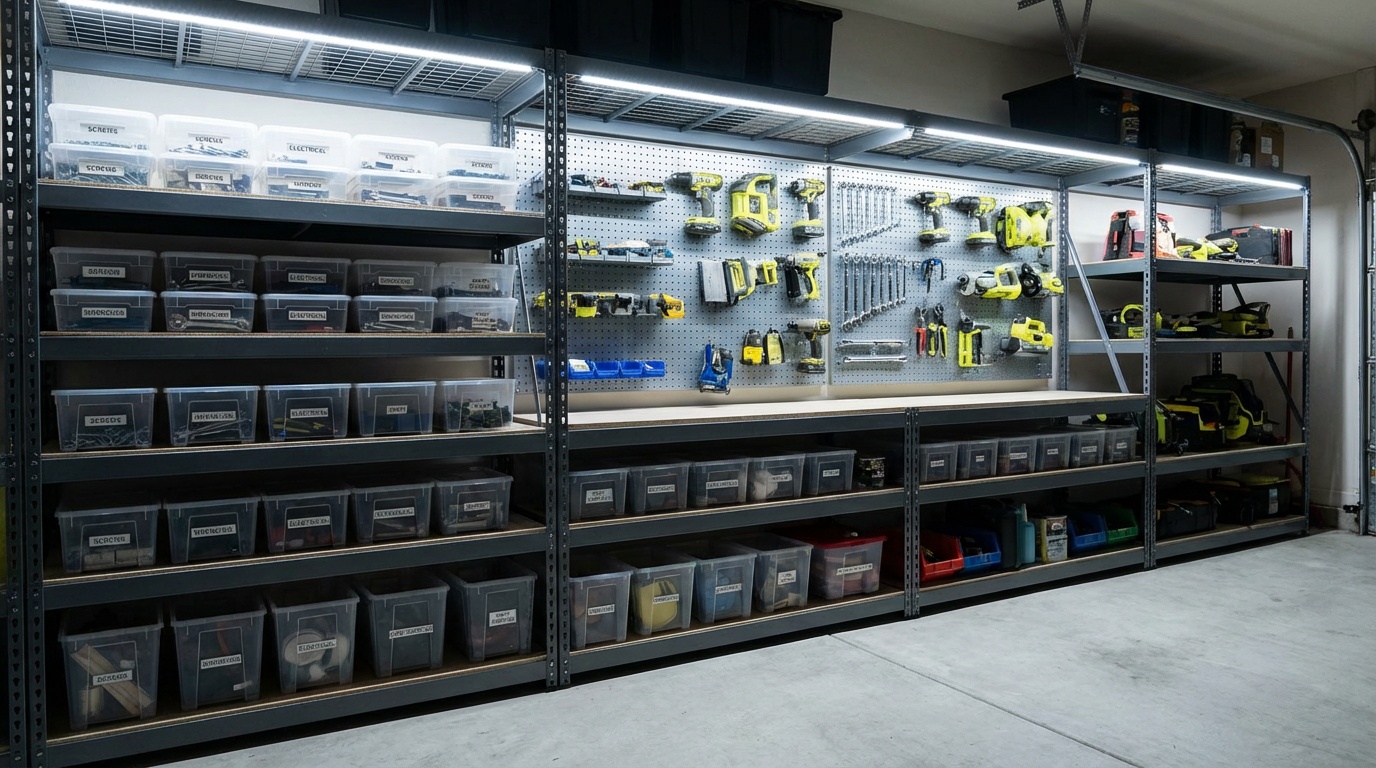
Garage Organization Systems: Best Uses for Shelving, Hooks, and Overhead Racks
Reading time: 14 minutes
Be honest — when was the last time you actually parked your car in the garage? If the answer involves phrases like “a couple of years ago” or “I think there’s still space near the water heater,” you’re in excellent company. A 2025 survey by the National Association of Home Builders found that over 64% of American homeowners use their garage primarily as storage, not vehicle shelter. And yet, most of those same garages are chaotic, inefficient, and frankly, a little bit dangerous.
Here’s the good news: transforming a cluttered garage into a beautifully organized, highly functional space doesn’t require a contractor, a massive budget, or a weekend of tears. It requires a system — and the right combination of shelving units, wall hooks, and overhead storage racks can completely change how you experience your home’s most underutilized square footage.
This guide is your strategic roadmap. Whether you’re starting from scratch or refining an existing setup, we’ll walk you through exactly what works, what doesn’t, and how to make smart decisions for your specific space in 2026.
Table of Contents
- Why Garage Organization Actually Matters
- Shelving Systems: The Foundation of Your Garage
- Wall Hooks and Pegboards: Vertical Space Done Right
- Overhead Racks: The Final Frontier of Storage
- Comparing Your Options: A Side-by-Side Breakdown
- Common Challenges and How to Overcome Them
- Real-World Case Studies: Three Garages Transformed
- Storage Impact: A Data Visualization
- Frequently Asked Questions
- Your Organized Garage Awaits: Next Steps
Why Garage Organization Actually Matters in 2026
The garage has evolved dramatically over the past decade. Where it was once simply a place to store tools and park cars, it now functions as a home gym, workshop, mudroom, hobby space, and secondary living area — often simultaneously. The rise of remote work since 2020 and the ongoing home improvement boom has pushed garage renovation spending to record highs. According to Remodeling Magazine’s 2025 Cost vs. Value Report, a mid-range garage organization overhaul now delivers an average 72% return on investment at resale — one of the highest among all home improvement categories.
But beyond financial returns, there’s a quality-of-life argument that’s equally compelling. A disorganized garage creates daily friction: time wasted searching for tools, safety hazards from stacked boxes, and the constant low-grade stress of visual clutter. A well-designed storage system eliminates that friction entirely.
The core principle: Effective garage organization isn’t about owning less — it’s about assigning everything a deliberate, accessible home.
Shelving Systems: The Foundation of Your Garage
If hooks and overhead racks are the supporting cast, shelving is the star of the show. Shelving provides the most versatile, universally applicable storage solution for garages of any size and configuration. But not all shelving is created equal — and choosing the wrong type can cost you both money and usability.
Types of Garage Shelving: Which One Is Right for You?
Let’s cut through the noise and break down your primary options:
- Freestanding Metal Shelving: The workhorse of garage storage. Units from brands like Gladiator, Husky, and Costco’s Whalen line offer load capacities of 200–2,000 lbs per shelf and typically range from $80–$400 per unit. Best for: heavy items like paint cans, power tools, and bulk supplies.
- Wall-Mounted Slatwall Systems: Modular panels that attach to studs and accommodate interchangeable accessories. Popular with serious hobbyists and workshop owners. Best for: flexible, reconfigurable layouts that evolve over time.
- Adjustable Wire Shelving: Lightweight, ventilated, and rust-resistant. Ideal for garages with moisture concerns. Best for: sports equipment, seasonal decorations, and items that benefit from airflow.
- Ceiling-Mounted Fixed Shelving: Permanently anchored to joists, these are ideal for seasonal storage. Best for: rarely accessed items like holiday décor and camping gear. (Often overlaps with overhead rack functionality.)
- Modular Cabinet Systems: Lockable, finished cabinetry — often used in high-end garage makeovers. Best for: hazardous materials, tools requiring security, or aesthetics-forward setups.
How to Position Shelving for Maximum Efficiency
Placement is everything. A common mistake homeowners make is lining shelves along a single wall and calling it done. In 2026, professional organizers recommend a zone-based approach — dividing your garage into functional zones (automotive, sports/recreation, tools/workshop, seasonal, gardening) and building shelving configurations that serve each zone specifically.
Practical shelving tips you can implement today:
- Place frequently accessed items at eye level (roughly 48–60 inches from the floor).
- Reserve lower shelves for heavy, stable items like buckets, bags of mulch, or tool chests.
- Use upper shelves (above 72 inches) only for lightweight, infrequently needed items.
- Leave 18–24 inches between the top shelf and the ceiling for ventilation and clearance.
- Label every shelf section — it sounds basic, but it’s the single most powerful habit for maintaining long-term organization.
Pro Tip: Measure your garage doors’ swing radius or your car’s side mirrors before installing shelving along side walls. A 2024 consumer survey found that 23% of garage shelving installations had to be partially removed within a year due to clearance conflicts with vehicles.
Wall Hooks and Pegboards: Vertical Space Done Right
Here’s a truth that most homeowners overlook: the average two-car garage has approximately 400–600 square feet of vertical wall space — and the majority of it sits completely unused. Wall hooks and pegboard systems are the most cost-effective way to reclaim that space, often costing less than $200 for a complete setup that dramatically increases storage capacity.
Understanding Hook Types and Load Ratings
Not all hooks can handle the same load, and mismatching hook type to application is a recipe for disaster (literally — a fallen bicycle or heavy ladder is a serious safety hazard). Here’s how to think about it:
- Single utility hooks (S-hooks): For light items — garden hoses, jump ropes, extension cords. Typically rated to 10–25 lbs.
- Double-prong bike hooks: Designed to hold bicycles horizontally by the frame or wheel. Rated 40–75 lbs when properly anchored to studs.
- Overhead ceiling hooks: For bikes stored vertically, punching bags, or hammocks. Require secure joist anchoring — minimum 3-inch lag screws into solid wood.
- Heavy-duty utility hooks: For ladders, wheelbarrows, and large sporting equipment. High-quality versions (like Monkey Bar Storage or StoreYourBoard systems) are rated to 100+ lbs.
- Pegboard hooks: Versatile and interchangeable, but dependent on pegboard quality. Use ¼-inch hardboard or steel pegboard for tools heavier than 5 lbs.
Rule of thumb: Always anchor hooks into wall studs (typically 16 or 24 inches on center), not just drywall. Drywall alone can support approximately 10–15 lbs with a proper anchor — far less than most garage applications require.
Pegboard Layouts That Actually Work
Pegboards have made a huge comeback in 2025–2026, driven partly by the “organized workshop aesthetic” that’s taken over home improvement social media. But beyond aesthetics, a well-designed pegboard genuinely transforms tool accessibility. Consider these layout strategies:
- The Workshop Wall: Install a full 4×8-foot pegboard panel behind your workbench. Outline each tool’s silhouette with a marker — you’ll always know exactly where each tool belongs and can immediately spot what’s missing.
- The Sports Hub: Dedicate a pegboard panel near the garage entry door to frequently used sports equipment — balls in bins, helmets on hooks, racquets on pegs. Grabs in, grabs out.
- The Garden Station: Near the back or side door, install hooks for hand tools, a shelf for gloves and seed packets, and wire baskets for small pots. Your gardening routine becomes seamless.
Modern pegboard accessories have evolved well beyond basic hooks. In 2026, you’ll find dedicated holders for power drills, magnetic strips for screwdrivers, clear acrylic bins for screws and hardware, and even integrated LED lighting strips designed for pegboard frames.
Overhead Racks: The Final Frontier of Storage
If shelving is your foundation and hooks are your walls, overhead racks are your ceiling — and most homeowners are leaving enormous amounts of usable space completely empty above their heads. The average 2-car garage has 10–12 feet of ceiling height, and the 4–5 feet between the top of your car and the ceiling joists represents prime real estate for seasonal or infrequently accessed storage.
Overhead ceiling racks have surged in popularity, with the global garage storage market projected to reach $4.2 billion by 2027, with ceiling-mounted solutions representing one of the fastest-growing subcategories according to Grand View Research’s 2025 report.
Choosing the Right Overhead Rack System
The key decision points when evaluating overhead rack systems:
- Weight capacity: Quality ceiling racks range from 250 lbs (basic residential) to 600+ lbs (heavy-duty systems). Always purchase a system rated at least 30% above your anticipated load.
- Ceiling height compatibility: Most systems are designed for 8–12-foot ceilings. Check clearance requirements — you need at least 4 inches between the rack bottom and your vehicle’s roofline when loaded.
- Drop height adjustability: The best systems allow you to set the drop height between 22–45 inches from the ceiling, giving you flexibility as your storage needs change.
- Grid size: Standard racks come in 4×8-foot sections, but modular systems let you build custom configurations. A 4×8 overhead platform provides approximately 32 square feet of storage — enough for bins of holiday decorations, camping gear, and seasonal sports equipment.
Top-rated systems in 2026 include the Fleximounts 4×8 Overhead Garage Storage Rack (consistently rated among the highest for ease of installation and load stability), the Racor Pro Ceiling Storage System (excellent for sloped ceilings), and the NewAge Products Overhead Storage system (best-in-class for garage cabinet integration).
Safety First: Installation Non-Negotiables
Overhead rack failure is not just inconvenient — it’s genuinely dangerous. Before you install:
- Locate all ceiling joists using a quality stud finder (not just a basic magnetic one — use an electronic model for accuracy).
- Verify joist integrity — older homes may have compromised wood that cannot safely carry the load. When in doubt, hire a structural engineer for a quick assessment (typically $150–$300 in 2026).
- Use only the hardware provided by the manufacturer, or hardware rated above spec. Never substitute with generic bolts.
- Distribute weight evenly across the platform — don’t stack all heavy items on one end.
- Inspect mounting hardware every 6 months and tighten as needed. Vibration from garage door operation can gradually loosen connections.
Comparing Your Options: A Side-by-Side Breakdown
| Feature | Freestanding Shelving | Wall Hooks/Pegboard | Overhead Racks |
|---|---|---|---|
| Average Cost (2026) | $100–$400/unit | $30–$250/system | $150–$600/system |
| Ideal For | Heavy bins, tools, supplies | Bikes, tools, gear | Seasonal, rarely-used items |
| Installation Difficulty | Easy (30–60 min) | Moderate (1–3 hours) | Moderate–Hard (2–4 hours) |
| Weight Capacity | 200–2,000 lbs/shelf | 10–150 lbs/hook | 250–600 lbs/system |
| Space Efficiency | Moderate (uses floor) | High (vertical only) | Excellent (no floor use) |
Common Challenges and How to Overcome Them
Even the best-laid organizational plans run into real-world complications. Here are the three challenges we hear most often — and exactly how to solve them.
Challenge 1: “I Don’t Know Where to Start”
Decision paralysis is real, and it’s the number-one reason garages stay disorganized for years. The solution is deceptively simple: start with a complete purge before buying anything. Spend one weekend doing nothing but sorting — keep, donate, trash. You’ll almost certainly eliminate 30–40% of what you’re storing, which fundamentally changes what kind of storage system you actually need. Only after the purge should you measure, plan, and purchase.
Challenge 2: “My Garage Has Moisture Problems”
Humidity and moisture are the enemies of garage storage. If your garage experiences seasonal dampness, you need to factor this into every purchase decision. Choose powder-coated steel or polyethylene shelving over untreated wood or basic wire. Use sealed plastic bins rather than cardboard boxes. Elevate shelving at least 4 inches off the floor to prevent water damage from seasonal flooding or snow melt. And consider a dehumidifier — in 2026, smart dehumidifiers with app connectivity cost as little as $120 and can maintain optimal humidity levels automatically.
Challenge 3: “I Have an Awkward or Small Garage”
One-car garages, garages with low ceilings, or oddly shaped spaces require creative problem-solving. The key insight here is that corners and doors are gold. Corner shelving units maximize dead space. Over-door organizers on the inside of the garage entry door can store small items. Slim-profile rolling carts (4–6 inches deep) can tuck between a car and the wall. And in low-ceiling garages (under 8 feet), wall-mounted systems become even more critical — every inch of vertical wall space matters.
Real-World Case Studies: Three Garages Transformed
Case Study 1: The Suburban Family Garage — Columbus, Ohio
The Martinez family had a standard 2.5-car garage that had become completely unusable for vehicles. Their specific challenges: two bikes, a riding mower, a full set of power tools, three kids’ worth of sports equipment, and holiday storage for a large home. Their solution involved a three-phase system: First, heavy-duty freestanding shelving (two 5-tier Husky units) along the back wall for tools and supplies. Second, a full slatwall panel system on the right wall for bikes (mounted on vertical hooks), sports equipment, and seasonal items on interchangeable hooks and bins. Third, two Fleximounts 4×8 overhead racks suspended at 40-inch drop height for holiday bins. Total investment: approximately $1,100. Result: both cars now park inside, and the family reports spending 60% less time searching for items compared to before the reorganization.
Case Study 2: The Urban Single-Car Garage — Portland, Oregon
Jamie Chen’s 12×20-foot single-car garage doubled as a woodworking workshop. The challenge was maximizing workshop space while maintaining vehicle storage. Solution: A full 8-foot pegboard wall behind the workbench with custom tool outlines, wall-mounted French cleat system for power tools and accessories, two ceiling-mounted overhead racks above the vehicle space for lumber and plywood, and a single freestanding cabinet with locking drawers for finishing materials. Total investment: $680. The result was a fully functional workshop that still comfortably accommodates Chen’s SUV — a combination that seemed impossible before the organizational overhaul.
Case Study 3: The Weekend Warrior Garage — Denver, Colorado
For the Petersons, the garage was entirely dedicated to outdoor adventure — skiing, mountain biking, camping, and kayaking gear. Standard shelving alone wasn’t going to cut it. Their solution centered on a combination of heavy-duty double-prong bike hooks (four bikes stored horizontally on one wall), specialty ski and snowboard wall mounts, a ceiling hoist system for two kayaks, and modular bin shelving for camping gear. Zero freestanding shelving was used — every element was wall or ceiling mounted. Total investment: $890. Result: a space that actually enhances their outdoor lifestyle rather than making it more stressful.
Storage System Effectiveness: Space Reclaimed
Based on aggregated homeowner survey data from 2025, here’s how different garage storage solutions compare in terms of average usable space reclaimed per system installation:
Average Usable Floor Space Reclaimed by Storage System Type
*Percentage reflects floor space equivalence freed relative to footprint occupied. Source: Home Organization Industry Association, 2025 Survey Data.
The data tells a clear story: the more vertical and overhead-focused your storage strategy, the more floor space you reclaim. Freestanding shelving, while highly useful and load-bearing, occupies its own footprint — which is why the best garage systems use freestanding shelving strategically, not exclusively.
Frequently Asked Questions
How much weight can my garage ceiling safely support for overhead racks?
This depends on your ceiling construction, but most residential garages built to standard code have ceiling joists (typically 2×6 or 2×8 lumber) capable of supporting 50–100 lbs per linear foot when properly anchored. A quality 4×8 overhead storage rack spanning two or three joists can safely hold 250–600 lbs depending on the system and proper installation. However, older homes, finished garages with drywall ceilings, or garages with attic space above may have different structural realities. When in doubt — and especially if you’re planning to load more than 300 lbs — consult a structural engineer. A $200 consultation is cheap insurance against a catastrophic failure.
What’s the best combination of storage systems for a typical 2-car garage?
For a standard two-car garage (approximately 400–440 sq ft), professional organizers in 2026 most commonly recommend this combination: one to two freestanding heavy-duty shelving units along the back wall for bulk storage and heavy items; a full wall of slatwall or pegboard along one side wall for tools, bikes, and sports equipment; one to two overhead rack systems above the vehicle parking areas for seasonal storage; and utility hooks near entry points for frequently used items like ladders, extension cords, and garden hoses. This layered approach utilizes all three dimensions of your garage — floor footprint, wall space, and ceiling space — to maximize total storage capacity without sacrificing usability.
Is it worth hiring a professional garage organizer, or is this a DIY project?
Both paths are legitimate — it really depends on your situation. DIY garage organization is absolutely achievable for most homeowners, especially with the quality of pre-designed kits available in 2026 from brands like Gladiator, Husky, and Fleximounts. Most freestanding shelving and basic hook systems require no special tools and can be completed in a single weekend. However, professional garage organizers deliver significant value in three specific scenarios: large or complex garages with multiple use cases; situations where custom cabinetry or built-in systems are desired; and when time is more valuable than money. Professional garage organization projects in 2026 typically range from $500 for a basic consultation and plan to $5,000–$15,000 for full custom installations.
Your Organized Garage Awaits: Next Steps That Actually Move the Needle
Here’s the thing about garage organization: the biggest barrier isn’t knowledge — it’s starting. You now have more strategic clarity than 90% of homeowners who tackle this project. So let’s convert that knowledge into action.
Your practical implementation roadmap for the next 30 days:
- Week 1 — Purge and assess: Spend one full day sorting everything in your garage into keep, donate, and discard. Then measure your garage (length, width, ceiling height, stud spacing) and photograph all four walls. This gives you the data you need to plan intelligently.
- Week 2 — Zone and plan: Using your measurements and photographs, sketch out your zone layout. Identify which walls will house shelving, which will feature hooks or pegboards, and whether overhead racks are feasible given your ceiling height and joist location. Free planning tools from brands like Gladiator and Husky let you visualize configurations digitally before purchasing.
- Week 3 — Purchase strategically: Buy one system at a time, starting with your highest-impact need. For most households, that’s either shelving or bike/sports hooks. Avoid buying everything at once — needs often evolve once you see the first system in place.
- Week 4 — Install, label, and refine: Install your chosen systems, label everything, and live with it for a week. Note what works and what creates friction. Make minor adjustments. Then plan your next phase.
The broader truth here is that a well-organized garage is a microcosm of intentional home design — a trend that’s reshaping how we think about living spaces in 2026. As remote work, home-based hobbies, and multi-use living continue to define how we inhabit our homes, the garage has become one of the most valuable improvement frontiers available to homeowners.
So here’s the question worth sitting with: What would your daily life look like if your garage actually worked for you? That vision is entirely achievable — and it starts this weekend.
Article reviewed by Nina Svensson, Interior Architecture & Color Design Consultant, on May 4, 2026