
Junk Removal vs. DIY Dumpster Rental: A Cost and Convenience Comparison
Reading time: 12 minutes
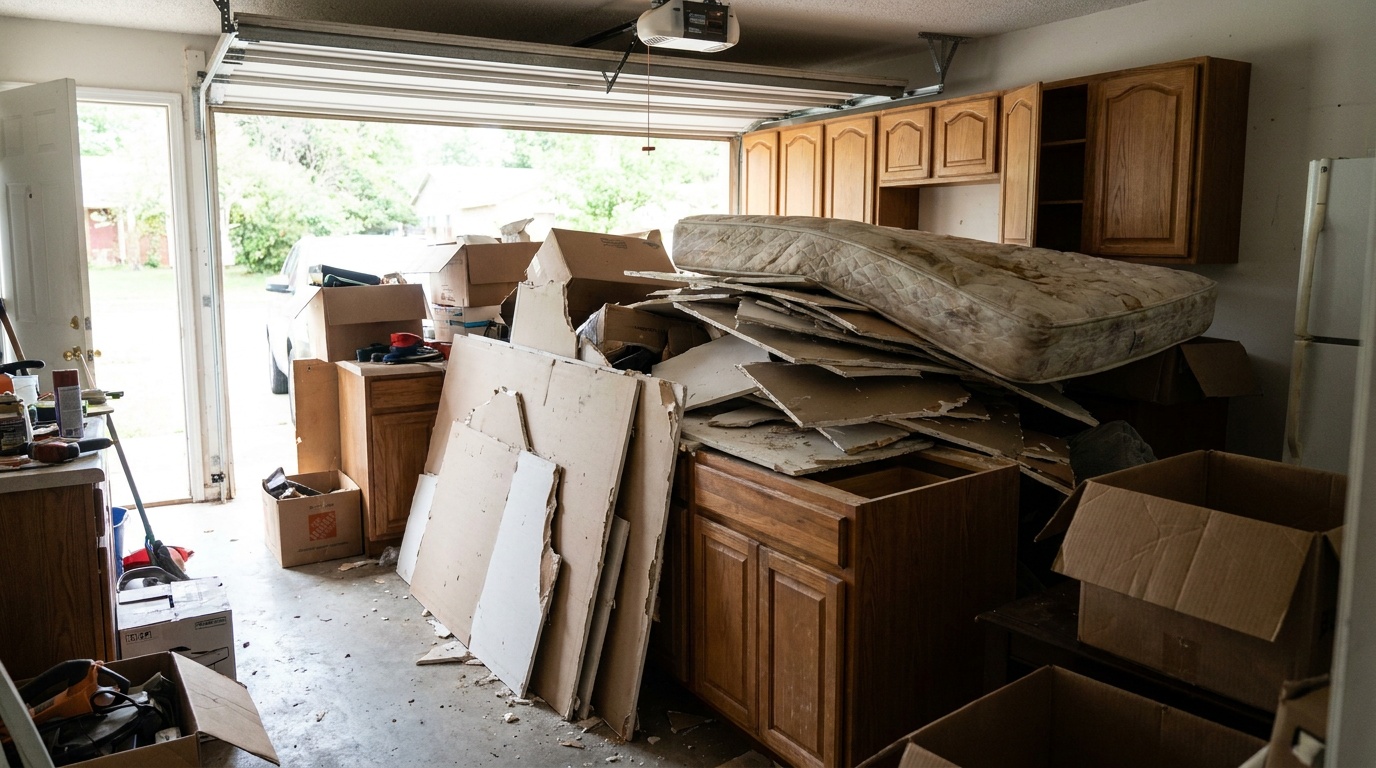
Picture this: You’ve just finished a major home renovation, and your garage looks like a landfill exploded inside it. There’s drywall debris, old cabinetry, a mattress that’s seen better days, and enough random junk to fill a small truck. You know you need to deal with it — but how?
In 2026, Americans are generating more residential waste than ever before. According to the EPA’s most recent data, the average U.S. household produces approximately 4.9 pounds of waste per day, and that number climbs dramatically during cleanouts, renovations, and relocations. You’re facing a genuine fork in the road: hire a junk removal service and pay a premium for convenience, or rent a dumpster and handle the heavy lifting yourself.
Neither option is universally “better.” The right choice depends on your specific situation — your budget, your timeline, the type of debris you’re dealing with, and your physical capacity to do the work. This guide cuts through the noise and gives you an honest, data-driven comparison so you can make the call that makes sense for you.
Table of Contents
- Understanding Both Options
- Cost Breakdown: What You’ll Actually Pay in 2026
- The Convenience Factor: Time, Labor, and Logistics
- Side-by-Side Comparison
- When to Choose Which Option
- Real-World Examples and Case Studies
- Hidden Costs and Common Pitfalls
- Frequently Asked Questions
- Making the Smart Choice: Your Decision Roadmap
Understanding Both Options
Before we get into the dollars and cents, let’s make sure we’re comparing apples to apples. These two services are fundamentally different in how they operate — and understanding those differences is the foundation of making a smart decision.
What Is a Professional Junk Removal Service?
Junk removal companies like 1-800-GOT-JUNK?, Junk King, and College Hunks Hauling Junk send a crew to your property, load your debris for you, haul it away, and handle all disposal logistics. You point, they lift. It’s a full-service experience from start to finish.
These companies typically charge based on the volume of junk they remove, measured in fractions of a standard truck (which holds approximately 12–15 cubic yards). Most companies provide an on-site estimate before any work begins, and you pay only after you’ve approved the quote. In 2026, the industry has also expanded significantly into eco-conscious disposal — many services now actively sort materials for recycling and donation before anything goes to the landfill.
What Is a DIY Dumpster Rental?
Dumpster rental — sometimes called a roll-off rental — involves having a large steel container delivered to your property. You fill it yourself at your own pace, and the company picks it up when you’re done. Rental periods typically range from 3 to 14 days, though extensions are usually available for an additional fee.
Dumpsters come in several sizes — commonly 10, 15, 20, and 30 cubic yards — to suit projects ranging from a small bathroom cleanout to a full home demolition. You do all the physical labor: hauling debris from wherever it is to the dumpster sitting in your driveway. The rental company handles pickup and disposal.
Cost Breakdown: What You’ll Actually Pay in 2026
Here’s where most comparisons fall short — they quote base prices without acknowledging the full picture. Let’s get granular.
Junk Removal Service Pricing
In 2026, the average cost of professional junk removal in the United States ranges from $150 to $600 for a typical residential job, with national averages sitting around $300–$400 for a half-truck load. Full truck loads can reach $600–$800+ depending on your location, the type of materials, and current fuel surcharge rates.
Pricing is typically structured as follows:
- Minimum load (⅛ truck): $90–$150
- Quarter truck: $150–$250
- Half truck: $275–$425
- Full truck (12–15 cu yd): $550–$800
- Special items (appliances, mattresses, tires): $25–$75 per item surcharge
Urban markets like New York City, San Francisco, and Boston will push you toward the higher end of these ranges. Suburban Midwest markets will typically come in 20–30% lower.
DIY Dumpster Rental Pricing
Dumpster rental costs in 2026 vary significantly by size and region, but here are realistic national averages:
- 10-yard dumpster: $280–$420 (3–5 days)
- 15-yard dumpster: $340–$490
- 20-yard dumpster: $380–$560
- 30-yard dumpster: $490–$750
These prices typically include delivery, pickup, and a baseline weight allowance (usually 1–3 tons). Overweight fees — commonly $50–$80 per ton over the limit — are one of the most frequent surprise costs renters encounter. Additionally, permit fees for placing a dumpster on a public street can run $25–$150 depending on your municipality.
The hidden labor cost: Most people forget to factor in their own time and physical effort. If you’re spending 8–12 hours loading a dumpster (which is realistic for a full home cleanout), and you value your time at even $25/hour, you’re looking at an invisible $200–$300 expense that never appears on any invoice.
The Convenience Factor: Time, Labor, and Logistics
Cost is only half the equation. Let’s talk about what each option actually demands from you.
The Junk Removal Experience: Hands-Off Efficiency
The core appeal of junk removal is simplicity. Most companies can book same-day or next-day appointments — a significant upgrade from even five years ago. You show the crew what needs to go, they handle everything else: loading, sorting, recycling, donation drop-offs, and landfill runs.
For elderly homeowners, people with physical limitations, or busy professionals who genuinely cannot dedicate a weekend to heavy lifting, this isn’t just convenient — it’s essential. A 2025 survey by HomeAdvisor found that 67% of homeowners who chose junk removal cited time savings as their primary motivation, outranking cost considerations by a significant margin.
The downside? You have very little control over when the crew arrives, how they sort materials, or exactly what happens to your items. If sustainability matters to you, you’ll want to specifically ask about their recycling and donation practices before booking.
The Dumpster Rental Experience: Flexibility on Your Schedule
Dumpster rental puts you in the driver’s seat — literally and figuratively. You work when it suits you, at whatever pace you can manage. This is genuinely valuable for ongoing projects: a gradual estate cleanout, a multi-week renovation, or a situation where you’re not sure exactly how much junk you’re dealing with until you’re knee-deep in it.
However, that flexibility comes with genuine demands. You’ll be doing physical labor — often significant physical labor. Debris that looks manageable in a garage can be surprisingly heavy. Old furniture, construction materials, and appliances require proper lifting technique and sometimes additional equipment like dollies or furniture sliders. Without preparation, you’re risking injury.
You also need to think about logistics: Do you have a driveway? Is there clearance for a delivery truck? Will your HOA allow a dumpster on the property? These aren’t insurmountable obstacles, but they require advance planning that junk removal simply doesn’t demand.
Side-by-Side Comparison
| Metric | Junk Removal Service | DIY Dumpster Rental |
|---|---|---|
| Average Cost (Mid-Range Job) | $300–$450 | $380–$560 (20 yd) |
| Physical Labor Required | None (crew does it all) | High (you load everything) |
| Time to Complete | 1–3 hours (same day) | 3–14 days (your pace) |
| Best For | Quick cleanouts, large items, limited mobility | Renovation debris, ongoing projects, budget-conscious |
| Flexibility | Low (one-time visit) | High (work at your pace) |
Cost and Effort Visualization
The chart below illustrates how key factors compare between the two options, scored on a scale of 1–10 (higher = more favorable to the consumer):
When to Choose Which Option
Here’s the straight talk: the “best” option doesn’t exist in a vacuum. It depends entirely on your specific situation. Let’s map it out clearly.
Choose Junk Removal When…
- You have a time-sensitive deadline (closing on a house, meeting a contractor’s start date)
- Your load includes large or heavy items — appliances, furniture, hot tubs — that require specialized equipment or multiple people
- You have physical limitations that prevent heavy lifting
- Your junk is scattered across multiple areas of the property and would require significant organization before loading
- You want someone else to handle responsible disposal, including donation drop-offs
- You live in a dense urban area without driveway space for a roll-off container
Choose a Dumpster Rental When…
- You’re managing a renovation project with ongoing debris accumulation
- You have several days or weeks to complete the cleanout at your own pace
- Your debris consists primarily of construction materials — drywall, wood, tiles — that are awkward but manageable
- You have friends or family who can help with the physical labor
- You’re working with a tighter budget and can invest time to offset cost
- You have a suitable driveway or off-street space for placement
Real-World Examples and Case Studies
Theory is useful. Real examples are better. Here are two scenarios that reflect the kinds of decisions homeowners across America are navigating in 2026.
Case Study 1: The Estate Cleanout in Phoenix, AZ
When Marcus and his sister inherited their mother’s home in early 2026, they faced a 1,400-square-foot house filled with 40 years of accumulated belongings — furniture, clothing, kitchenware, tools, and what Marcus generously described as “a museum of everything from 1980 to 2020.” They initially leaned toward a dumpster rental because it seemed cheaper.
After getting quotes, the math shifted. A 20-yard dumpster came in at $475, but their estimate for heavy items that would push them over the weight limit added another $160 in potential overage fees. More critically, neither of them lived in Phoenix full-time. Flying back to spend a long weekend loading a dumpster wasn’t just inconvenient — it was genuinely costly when flights were factored in.
They hired a local junk removal service for $580, which included full-truck removal, donation of usable furniture to a local nonprofit, and same-day completion. The entire project was done before Marcus boarded his return flight. Was it more expensive? Yes — by roughly $100–$200. Was it the right call? Absolutely.
Case Study 2: The Kitchen Renovation in Columbus, OH
Sandra was gutting her kitchen — new cabinets, countertops, flooring, and appliances. She knew from the start this would generate significant debris over several weeks. Her contractor began demo in early March 2026, and the debris started piling up immediately.
Sandra rented a 15-yard dumpster for $395 with a 10-day rental period. Her contractor and his crew loaded construction waste as they worked, making the process seamless. When tile and old cabinetry pushed her toward the weight limit, she called for a swap-out — a second container was delivered for an additional $280, bringing her total to $675.
A junk removal service quoted her $750 for a one-time full-truck pickup at the end of the project — but that would have required her to store debris somewhere for weeks. The dumpster rental, despite the swap-out cost, was both more convenient for her specific project timeline and ultimately more affordable. For ongoing renovation projects, dumpster rental almost always wins on both fronts.
Hidden Costs and Common Pitfalls
This is where well-intentioned budgets go sideways. Whether you choose junk removal or dumpster rental, there are landmines you need to watch for.
Hidden Costs with Junk Removal
- Item-specific surcharges: Mattresses ($25–$50 each), appliances with refrigerants ($35–$75), and tires ($15–$35 each) often carry additional fees not reflected in the base quote.
- Fuel surcharges: With diesel prices fluctuating in 2026, many companies have reinstated explicit fuel surcharges of 5–12% on top of quoted prices.
- Stair fees: Items that require crews to navigate multiple flights of stairs typically add $25–$75 to the bill.
- Minimum load fees: Have just a few items? You’ll likely still pay the minimum charge (often $90–$150), even if your junk barely fills a corner of their truck.
Hidden Costs with Dumpster Rental
- Overweight charges: This is the most common — and most costly — surprise. Always ask what the included weight allowance is and estimate your debris weight before committing to a size.
- Prohibited items: Most rental agreements prohibit hazardous materials (paint, chemicals, batteries), electronics, and certain appliances. Disposal of prohibited items can result in additional charges of $50–$200 or more.
- Street placement permits: If your driveway can’t accommodate the container, you may need a municipal permit, ranging from $25 to $150 depending on your city.
- Extension fees: Need more time? Rental extensions typically run $30–$50 per additional day.
- Damage to surfaces: Roll-off dumpsters can crack or stain driveways. Asking for protective boards to be placed under the container is a smart precaution many renters discover too late.
Pro Tip: When getting quotes from either type of service, always ask for a fully itemized estimate that includes all potential fees. A reputable company will provide this willingly. If they’re evasive about fees, treat that as a red flag.
Frequently Asked Questions
Is junk removal always more expensive than renting a dumpster?
Not necessarily. For smaller loads — a few items or less than a quarter-truck’s worth of debris — junk removal can actually be comparable or even cheaper than renting a dumpster. When you factor in that dumpster rentals have minimum fees regardless of how full the container is, and that your time has real value, the cost gap narrows significantly for smaller jobs. For larger projects with lots of debris, dumpster rentals tend to offer better value on a per-cubic-yard basis, assuming you can do the loading yourself.
What items can’t go in a dumpster rental?
Most dumpster rental companies prohibit hazardous materials including paint, solvents, oils, pesticides, asbestos-containing materials, and certain electronics (e-waste). Many also restrict appliances that contain refrigerants (like air conditioners and refrigerators) unless the refrigerant has been professionally removed. Tires and batteries are frequently prohibited as well. Always read the rental agreement carefully and ask your provider directly about any borderline items. For prohibited materials, local hazardous waste drop-off events — increasingly common in 2026 — are often the most responsible and affordable disposal route.
How do I choose the right dumpster size?
The most common mistake DIY renters make is choosing a dumpster that’s too small — then paying for a swap-out or overflow. As a general rule: a 10-yard dumpster suits a single-room cleanout or small bathroom renovation; a 15-yard handles a garage or basement cleanout; a 20-yard is suitable for most whole-home cleanouts or kitchen renovations; and a 30-yard is appropriate for full demolition debris or large-scale construction projects. When in doubt, size up — the difference in rental price between adjacent sizes is usually only $50–$100, which is far less than the cost of a swap-out or overweight fee.
Making the Smart Choice: Your Decision Roadmap
You’ve got the full picture now. Let’s make it actionable. Here’s a straightforward roadmap to help you reach your decision with confidence:
- Inventory your junk first. Walk through and estimate the volume (cubic yards) and weight of what needs to go. This one step prevents most budgeting surprises for both options.
- Assess your physical capacity honestly. Can you safely do the loading? Do you have help? If the answer to either is uncertain, lean toward junk removal — injury costs far more than any service fee.
- Get at least two quotes from each category. In 2026, most companies offer instant online estimates or fast phone quotes. Spend 20 minutes comparing before committing to anything.
- Factor in your full timeline. Is this a one-day job or a multi-week project? Timeline mismatch is the most common reason people choose the wrong option.
- Ask about eco-friendly practices. If responsible disposal matters to you, specifically ask both junk removal companies and dumpster services what happens to your materials — because the answers will surprise you.
The waste management industry is evolving rapidly. By 2027, we expect to see further expansion of AI-powered load estimation tools, broader adoption of zero-landfill policies by major junk removal chains, and more competitive pricing as the dumpster rental market consolidates. Staying informed means staying ahead of these shifts.
Here’s the question worth sitting with: What’s your time actually worth to you this weekend? Because when you answer that honestly, the right choice usually becomes obvious — and it often has less to do with the quoted price on any invoice than you might think. Start with your gut, validate with the numbers, and make the call that lets you move forward without regret.
Article reviewed by Nina Svensson, Interior Architecture & Color Design Consultant, on May 4, 2026