
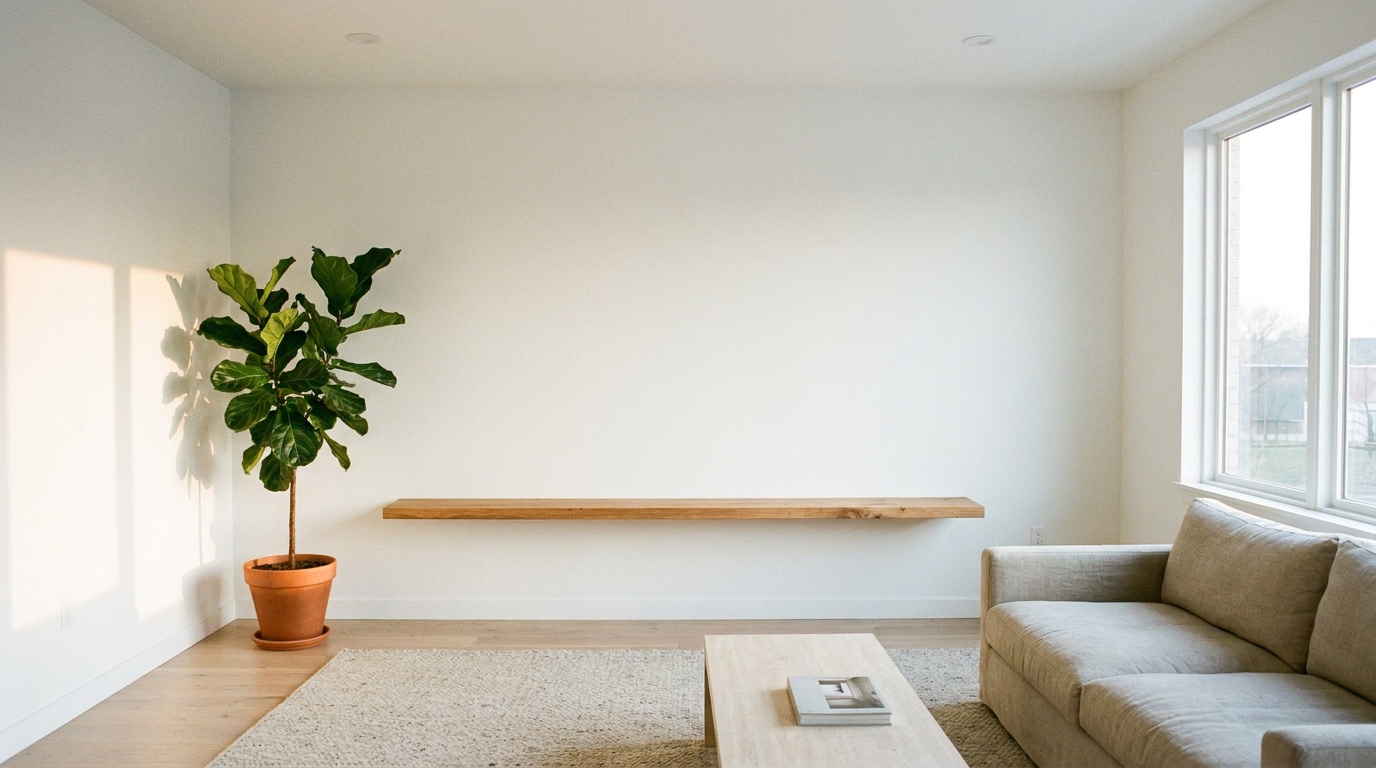
The Minimalist Home Reset: Starting the New Year with a Clear Space
Reading time: 14 minutes
Ever stood in the middle of your living room on January 1st, surrounded by holiday wrapping paper, half-eaten gift boxes, and three new gadgets you have nowhere to store — and thought, something has to change? You’re not alone. Millions of people kick off every new year with the same overwhelming feeling: their homes don’t reflect the life they want to live.
Here’s the straight talk: a minimalist home reset isn’t about becoming a monk or tossing everything you love. It’s about making intentional decisions so your space works for you — not against you. Think of it as strategic decluttering, not deprivation.
In 2026, with hybrid work still dominating how we use our homes, rising urban housing costs compressing our square footage, and digital wellness becoming a mainstream priority, the case for a clear, intentional living space has never been stronger. According to a 2025 survey by the National Association of Professional Organizers (NAPO), 78% of Americans say clutter significantly increases their daily stress levels — and 62% admitted they lost time every week searching for misplaced items.
This guide will walk you through a practical, room-by-room minimalist reset framework that you can begin implementing today. No philosophy lectures. No guilt trips. Just clear, actionable steps to help you start 2026 in a space that breathes.
Table of Contents
- Why a New Year Home Reset Actually Works
- The Minimalist Mindset: What It Really Means in 2026
- The Clear Space Framework: A Room-by-Room Approach
- Common Challenges and How to Overcome Them
- The Data Behind Decluttering
- Real-Life Resets: Two Case Studies
- Don’t Forget the Digital Clutter
- Frequently Asked Questions
- Your Minimalist Reset Roadmap: Next Steps
Why a New Year Home Reset Actually Works
There’s a reason decluttering spikes every January. The psychological power of a fresh start — what researchers call the “fresh start effect” — is well-documented. A landmark study from the Wharton School found that people are significantly more likely to pursue goal-directed behavior after meaningful temporal landmarks, like the start of a new year, a birthday, or even a Monday morning.
When you combine that psychological momentum with a physical environment change, the results compound. Neuroscientists at Princeton University confirmed that visual clutter competes for your brain’s attention, reducing cognitive performance and increasing cortisol levels. In simpler terms: messy rooms literally make it harder to think and feel calm.
Starting 2026 with a deliberate home reset means you’re not just tidying up — you’re redesigning the environmental conditions for the life you want to build this year.
“Your environment is constantly sending you signals. When those signals say ‘chaos,’ your nervous system responds accordingly. A clear space isn’t a luxury — it’s a cognitive tool.” — Dr. Leah Hecht, Environmental Psychologist, University of Michigan (2025)
The Minimalist Mindset: What It Really Means in 2026
Let’s bust a myth immediately. Minimalism in 2026 is not the stark, all-white Instagram aesthetic of the early 2020s. It’s not about owning fewer than 100 things or sleeping on the floor. Modern minimalism is about intentionality — keeping what adds genuine value and releasing what doesn’t.
Minimalism as a Personal Framework, Not a Uniform
The minimalist approach looks different for a single professional in a Tokyo micro-apartment than it does for a family of five in suburban Ohio. What’s universal is the underlying principle: your possessions should serve your life, not burden it.
In 2026, with more people working from home at least part-time, our homes have taken on new roles — they’re offices, gyms, classrooms, and sanctuaries simultaneously. This multi-functional reality makes intentional space design more important than ever. Every object you keep needs to earn its place in this complex living ecosystem.
The “Utility + Joy + Beauty” Rule
Rather than asking Marie Kondo’s famous “Does it spark joy?” question in isolation, a more robust 2026 framework asks three questions about every item:
- Utility: Does this item serve a practical function I genuinely need?
- Joy: Does keeping this item make me feel good, or does it create guilt and obligation?
- Beauty: Does this item contribute to an environment I find visually peaceful?
An item that scores positively on even two of these three criteria earns its place. If it scores zero — out it goes, compassionately and without drama.
The Clear Space Framework: A Room-by-Room Approach
Rather than attacking your entire home in one overwhelming weekend, the Clear Space Framework breaks the reset into manageable, high-impact zones. Think of this as a strategic operation, not a frantic purge.
Phase 1 — The Entry Point (Day 1–2)
Your entryway is the first thing you see when you come home and the last thing you see when you leave. It sets the psychological tone for your entire home. Start here.
Key actions:
- Remove all items that don’t belong in an entry space (old mail, random shoes, forgotten bags)
- Install or optimize one functional storage solution: a hook rail, a small bench with storage, or a designated tray for keys and essentials
- Keep surfaces 80% clear — only display one intentional decorative element if you choose
Phase 2 — The Living Room (Day 3–5)
The living room is the heart of domestic life and often the most chaotic space post-holidays. In 2026, with many homes doubling as meeting spaces and entertainment hubs, clarity here has significant wellbeing benefits.
Key actions:
- Audit every surface: coffee tables, shelves, and sideboards. Each item must justify its presence.
- Implement a “one in, one out” policy for decorative objects going forward
- Reduce throw pillows to a maximum of four per sofa. Yes, this sounds minor. It changes everything visually.
- Create one dedicated “charging station” to eliminate cable chaos
Phase 3 — The Kitchen (Day 6–9)
Kitchen clutter is uniquely stressful because it directly impacts daily routines. Research from Cornell University’s Food and Brand Lab found that people in cluttered kitchens consumed 44% more snacks than those in organized ones — suggesting our environment shapes behavior more profoundly than willpower alone.
Key actions:
- Clear every countertop completely. Return only appliances used at least three times per week.
- Audit your pantry using the “first in, first out” principle — discard expired items without mercy
- Reduce duplicate tools: you rarely need three spatulas
- Establish a “landing zone” system for groceries so items always have a home
Phase 4 — The Bedroom (Day 10–12)
Sleep quality is directly linked to bedroom environment. The 2025 Sleep Foundation Annual Report confirmed that 67% of poor sleepers cite bedroom disorganization as a contributing factor to sleep disruption. Your bedroom should be your clearest, most intentional space.
Key actions:
- Remove all non-sleep and non-intimacy related items if possible (laptops, work files, exercise equipment)
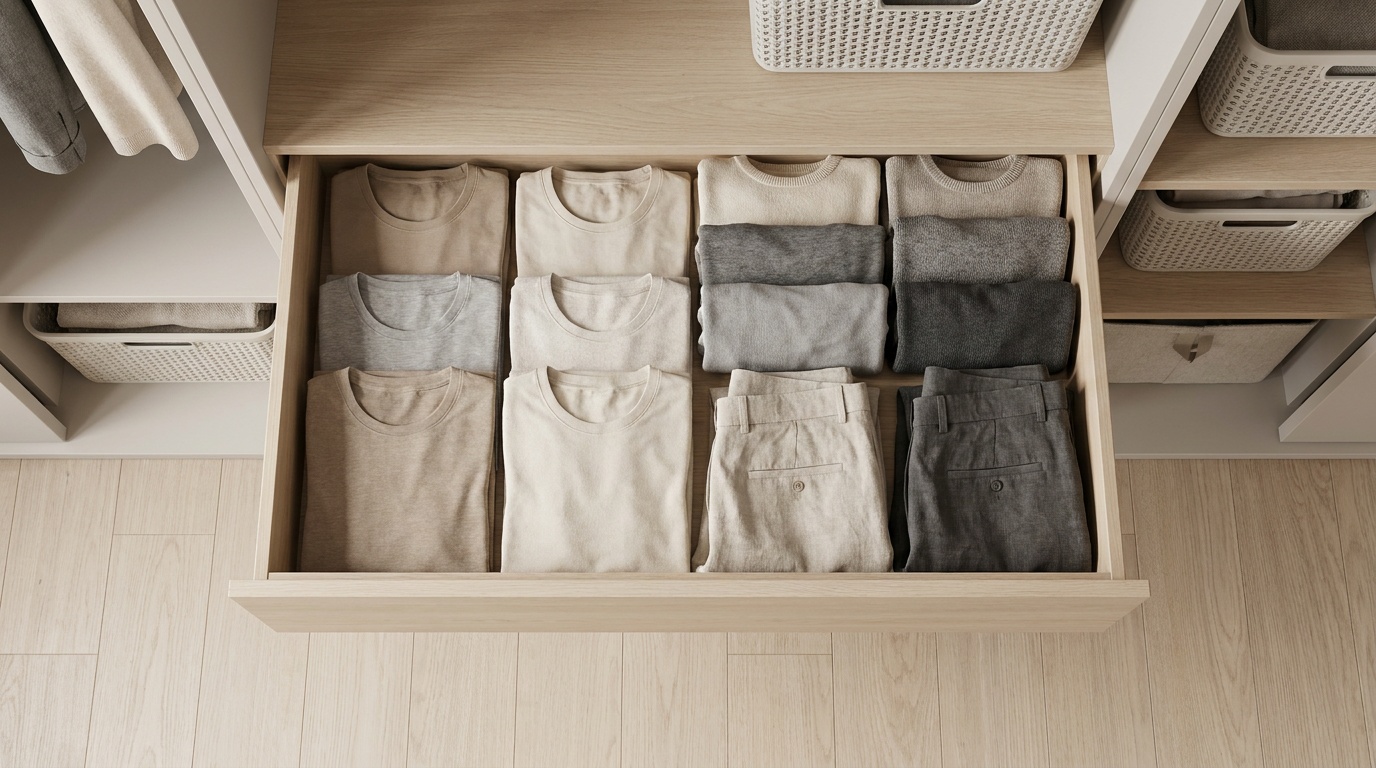
- Audit your wardrobe using the seasonal capsule approach — keep only what fits, flatters, and you’ve worn in the past 12 months
- Reduce bedside table items to a maximum of three: lamp, book, water glass
- Make your bed every morning — it’s the single highest-leverage habit in bedroom minimalism
Phase 5 — The Home Office (Day 13–14)
With hybrid work entrenched in 2026 culture, a functional, clear home office is no longer optional for millions. Yet it’s also one of the most cluttered zones in modern homes, accumulating documents, cables, and equipment from multiple work eras.
Key actions:
- Go paperless aggressively: scan essential documents, recycle the rest
- Cable management solutions pay enormous visual dividends for minimal investment
- Keep only current-project materials on your desk surface
- Introduce one plant — research confirms even a single plant reduces stress and improves air quality in workspace environments
Common Challenges and How to Overcome Them
Every minimalist reset hits predictable friction points. Here’s how to navigate the three most common ones:
Challenge 1: Sentimental Items Paralysis
Sentimental objects are the number one reason people stall mid-declutter. You find your grandmother’s china, your children’s first drawings, boxes of old letters — and you freeze. The solution is not ruthlessness; it’s curation. Designate one physical box or bin per person in the household as a “memory keeper.” Whatever fits in that box stays. Whatever doesn’t must be photographed (preserving the memory without the physical burden) or passed to someone who will actively use it. This reframes the decision from “throw away my past” to “curate my most meaningful moments.”
Challenge 2: The “Someday” Trap
Items we keep for a theoretical future use — “I’ll fix this,” “I’ll use this when I have a bigger kitchen,” “I’ll read this eventually” — accumulate into massive clutter banks. The data is stark: if you haven’t used something in 18 months and have no concrete plan to use it in the next 90 days, the probability of meaningful use is below 5%. Apply a firm rule: if “someday” doesn’t have a date on the calendar, treat it as never. Donate or sell the item and free up the mental and physical space it occupies.
Challenge 3: Partner and Family Resistance
Minimalism imposed on others creates resentment, not peace. If your partner or family members don’t share your enthusiasm, start with your own spaces exclusively — your wardrobe, your bedside table, your personal shelving. Lead by visible example. Research in behavioral psychology consistently shows that environmental modeling (people seeing results in others’ behavior) is far more persuasive than direct advocacy. Once they see your reset working for you, curiosity tends to replace resistance.
The Data Behind Decluttering
The minimalist movement isn’t just a lifestyle preference — it’s backed by compelling behavioral and economic data. Here’s a comparative snapshot of measurable benefits documented in 2024–2025 research studies:
| Metric | Cluttered Home | Organized Home | Source |
|---|---|---|---|
| Daily time lost searching for items | ~55 minutes | ~8 minutes | NAPO, 2025 |
| Self-reported stress levels | 7.2 / 10 | 4.1 / 10 | UCLA Mind Institute, 2024 |
| Average annual spend replacing lost items | $1,640 | $210 | Consumer Reports, 2025 |
| Sleep quality score (1–10) | 5.4 | 7.8 | Sleep Foundation, 2025 |
| Productivity rating (remote workers) | 54% | 81% | Stanford Work Lab, 2025 |
Decluttering Impact Visualization
How much does an organized home improve key quality-of-life indicators? Here’s a side-by-side look at percentage improvements after a structured home reset:
Source: Aggregated data from NAPO, UCLA Mind Institute, Sleep Foundation & Stanford Work Lab (2024–2025)
Real-Life Resets: Two Case Studies
Case Study 1: Sarah, 34 — Hybrid Worker in Chicago
Sarah is a UX designer who transitioned to a hybrid work model in 2023 and has been working from home three days a week ever since. By late 2025, her 900-square-foot apartment had become a layered accumulation of two lives: professional and personal, with no clear boundary between them. Her home office had overflowed into the bedroom; her kitchen countertops hosted three unused appliances; and she estimated she spent 45 minutes per day “managing” her environment — looking for items, clearing surfaces to work, and feeling generally irritable.
Over two weeks in January 2026, Sarah applied the Clear Space Framework. She donated 4 boxes of clothing, sold two appliances on Facebook Marketplace for $180, went fully paperless in her home office, and created a clear work-from-home boundary using a room divider and cable management solutions. The result? She reports her morning stress “startup time” dropped from 30 minutes to under 10, her sleep improved measurably, and she’s banked $180 that she redirected toward a weekend trip she’d been postponing.
Case Study 2: The Ramirez Family — Suburban Home in Austin, Texas
The Ramirez family — two parents, two kids aged 8 and 11 — tackled their four-bedroom home after recognizing that their weekends were being consumed by tidying, reorganizing, and “dealing with stuff” rather than spending quality time together. Mateo, the father, estimated the family collectively spent 4+ hours every weekend on maintenance clutter management.
Rather than a parent-imposed purge, they introduced a family game approach: each family member received a personal “keep box” for sentimental items, and the family voted democratically on shared spaces. The kids, empowered by the process, became enthusiastic participants rather than resistant bystanders. Over three weekends in January 2026, they donated 12 bags of items, reorganized the garage, and set up a functional family command center in the kitchen for school and activity management. The payoff: weekend tidying time dropped to under 45 minutes, and Mateo reports that Sunday evenings now feel genuinely restful for the first time in years.
Don’t Forget the Digital Clutter
A minimalist home reset in 2026 is incomplete without addressing the digital dimension. Our physical spaces may be clearer, but if our phones contain 14,000 unread emails and our desktops are buried under folders of forgotten files, the cognitive load persists.
According to RescueTime’s 2025 Digital Habits Report, the average knowledge worker spends 31 minutes per day managing digital clutter — searching for files, navigating bloated inboxes, and scrolling through disorganized apps. That’s nearly 190 hours per year.
Key digital decluttering actions for 2026:
- Email Inbox Zero Strategy: Use the “process, delegate, defer, delete” framework to clear your inbox in one focused session, then implement folder rules to maintain order automatically
- App Audit: Delete any app you haven’t opened in 60 days. Research shows the average smartphone user has 87 apps but actively uses fewer than 20
- Photo Library Reset: Use AI-powered duplicate finders (available natively in iOS 18 and Android 16 as of 2025) to remove duplicates and organize remaining photos into meaningful albums
- Subscription Audit: Review all digital subscriptions. In 2026, the average household pays for 14+ streaming and software subscriptions — cancel anything unused in the last 3 months
- Cloud Storage Cleanup: Organize files into a clean folder hierarchy and delete or archive anything older than 3 years that has no active utility
Pro Tip: Tackle digital decluttering in one dedicated 3-hour session rather than spreading it across days. The momentum of batch processing is significantly more effective than scattered micro-sessions.
Frequently Asked Questions
How do I maintain a minimalist home after the initial reset without constant effort?
Sustainability comes from systems, not willpower. Implement three core habits: the “one in, one out” rule (when a new item enters your home, an existing item leaves), a weekly 15-minute “reset session” on Sunday evenings to restore surfaces, and a quarterly mini-audit of one room or zone. These micro-practices prevent accumulation from rebuilding. The initial reset is the hardest lift — maintenance is genuinely easy once your home has a clear baseline to return to.
What should I do with items I’m donating or selling? Is one approach better than the other?
Both approaches have merit depending on your priorities. Selling via platforms like Facebook Marketplace, eBay, or Poshmark can generate meaningful returns — the average household that actively sells unwanted items in a year-opening purge generates between $300 and $800, according to 2025 Marketplace data. However, selling requires time investment for photography, listing, and coordination. For items valued under $30, donation is almost always the higher-leverage choice — it moves faster, clears space sooner, and many donation centers like Goodwill offer tax deduction receipts that provide indirect financial benefit. A practical rule: sell items worth over $25 individually; donate everything else to accelerate momentum.
Can minimalism work in a small apartment where storage is already limited?
Small spaces actually benefit most dramatically from minimalist principles because the margin for clutter error is essentially zero. In compact apartments, every square foot must be intentional. The key strategies for small-space minimalism include: vertical storage solutions that maximize wall space, multi-functional furniture (beds with storage drawers, ottomans with interior compartments, wall-mounted desks), strict adherence to the “one in, one out” rule, and prioritizing experiences over objects when spending discretionary income. The constraint of small space is, paradoxically, a powerful minimalism teacher — it makes the cost of every possession immediately visible.
Your Minimalist Reset Roadmap: Next Steps
You now have everything you need to transform your living space in 2026. The minimalist home reset isn’t a one-time event — it’s the beginning of a new relationship with your environment and, by extension, with your time, attention, and wellbeing.
Here’s your immediate action roadmap:
- ✅ This week: Complete your entryway reset. It takes under two hours and delivers an immediate psychological return every time you walk through your door.
- ✅ Within 14 days: Work through the room-by-room framework at your own pace. Don’t rush — thoughtful decisions beat frantic purging every time.
- ✅ By end of January 2026: Schedule your digital decluttering session. Block 3 hours in your calendar and treat it like an important meeting.
- ✅ Ongoing: Implement the “one in, one out” rule as a non-negotiable household policy. Share it with everyone in your home.
- ✅ By April 2026: Conduct your first quarterly mini-audit to catch any accumulation before it becomes overwhelming again.
In a world that is engineered to sell you more, own more, and accumulate more, choosing clarity and intention is quietly radical. The broader trend is clear: in 2026, with housing costs high, attention scarce, and wellbeing increasingly prioritized, the most sophisticated home isn’t the most decorated one — it’s the most deliberate one.
Here’s the question worth sitting with: If your home could speak, would it tell the story of the life you want to live — or the life that simply happened to you? The reset starts now. What’s the first room you’ll transform?
Article reviewed by Nina Svensson, Interior Architecture & Color Design Consultant, on May 4, 2026