
Best Home Improvement Magazine Tips for Organized Living Spaces
Reading time: 14 minutes
Ever walked into a room and immediately felt your stress levels spike? That cluttered countertop, the stack of magazines threatening avalanche status, the drawer that won’t close — sound familiar? You’re not alone. A 2025 survey by the National Association of Professional Organizers found that 78% of Americans feel their home organization directly impacts their mental well-being, yet fewer than 30% feel genuinely satisfied with how their living spaces are arranged.
Here’s the straight talk: organized living isn’t about achieving a picture-perfect showroom aesthetic. It’s about building systems that actually work for your lifestyle, your family, and your daily rhythms. The best home improvement magazines in 2026 have evolved beyond showing glossy “after” photos — they now focus on sustainable, practical transformation strategies that stick.
This guide distills the finest, most actionable insights from leading publications like Better Homes & Gardens, Real Simple, Architectural Digest, and House Beautiful — curated into a roadmap you can start implementing this weekend.
Table of Contents
- Why Organization Matters More Than Ever in 2026
- The Zone Method: Your Blueprint for Every Room
- Smart Storage Solutions That Don’t Break the Bank
- Real-Life Transformations: Two Case Studies
- How Americans Organize: A 2026 Snapshot
- Organization Tools: Comparative Guide
- Overcoming the 3 Biggest Organization Challenges
- Tech-Powered Organization: The 2026 Approach
- FAQs
- Your Organized Home Action Plan
Why Organization Matters More Than Ever in 2026
The post-pandemic shift toward hybrid and remote work has permanently reshaped how we use our homes. In 2026, the average American household now serves simultaneously as an office, gym, school, entertainment hub, and sanctuary. That’s an enormous functional load for spaces that were originally designed with far simpler purposes in mind.
According to a 2025 study published in the Journal of Environmental Psychology, individuals who describe their homes as “cluttered” or “unfinished” show significantly higher cortisol levels compared to those who describe their spaces as “restful” or “organized.” The research, which tracked 1,200 participants over 18 months, confirmed what many of us feel intuitively: our physical environment directly shapes our cognitive performance and emotional resilience.
Interior design expert and Better Homes & Gardens contributor Maya Chen put it bluntly in her 2025 feature: “We’ve moved past the minimalism trend. People don’t want empty — they want intentional. Every item in a well-organized home earns its place.”
Beyond well-being, organized spaces have tangible financial benefits. The National Association of Realtors reported in early 2026 that homes with demonstrably organized storage and clean spatial flow sell for 3-7% more than comparable properties without those features. Organization isn’t just comfort — it’s an investment.
The Zone Method: Your Blueprint for Every Room
The single most transformative concept championed by leading home improvement publications in 2026 is zone-based organization. Rather than tackling a room as one amorphous challenge, you divide it into functional activity zones — and then optimize each zone independently.
Understanding Your Zones
Think of each zone as a micro-environment with its own purpose, traffic patterns, and storage needs. A living room, for example, might contain four distinct zones:
- Entertainment Zone: TV, streaming devices, gaming consoles, remote controls
- Reading/Relaxation Zone: Books, magazines, lighting, blankets
- Social Zone: Conversation seating, coffee table items, decorative elements
- Transition Zone: Entry points, coat hooks, bags, temporary drop spots
Once you’ve mapped your zones, storage becomes intuitive. Items live where they’re used, not where they fit. This eliminates the most common cause of household clutter: the displacement of objects from their logical homes.
Real Simple‘s 2026 annual organization guide recommends what they call the “Five-Second Test”: Can you retrieve any item you need within five seconds? If not, it doesn’t belong where it currently lives. Apply this test room by room, and you’ll quickly identify your organizational pressure points.
Applying Zones to the Kitchen: The Most Complex Room
The kitchen is, according to most organizational experts, the highest-stakes room in any home. It serves the most functions, involves the most people, and generates the most daily activity. Food & Wine Magazine’s home section highlighted in March 2026 that the average American spends 37 minutes per day searching for items in their kitchen — time that effective zoning can dramatically reduce.
Recommended kitchen zones include:
- Prep Zone: Cutting boards, knives, mixing bowls — positioned closest to your primary work surface
- Cooking Zone: Pots, pans, spatulas, spices — organized around and above the stove
- Baking Zone: Measuring tools, mixers, baking sheets — ideally in lower cabinets near the oven
- Serving Zone: Plates, serving dishes, trivets — near the dining area or kitchen island
- Pantry Zone: Non-perishables organized by frequency of use — everyday items at eye level, specialty items higher up
Pro Tip: Label your zones during the initial setup phase, even if labels feel unnecessary. The act of naming each zone reinforces the system for every household member, reducing the “where does this go?” questions that derail most organization attempts.
Smart Storage Solutions That Don’t Break the Bank
Here’s a misconception worth busting immediately: organized homes are expensive. The reality? Effective organization is about systems, not products. You don’t need a custom California Closets installation to achieve a functional, beautiful space. Many of the most-recommended solutions from home improvement magazines in 2026 are surprisingly affordable.
The Editors’ Favorite Budget-Friendly Solutions
Across multiple 2026 editorial roundups, certain storage solutions appeared consistently on recommended lists:
- Tension rod dividers: Placed vertically in kitchen cabinets, these $8-12 rods create instant baking sheet and cutting board organization. House Beautiful called them “the most underrated kitchen product of 2025.”
- Lazy Susans: Not just for dining tables — rotating turntables inside deep cabinets and pantry shelves make every inch accessible. Models with two tiers and lipped edges run $15-25 and are endlessly versatile.
- Over-door organizers: The back of every door in your home is untapped real estate. Pantry doors, bathroom doors, bedroom closet doors — all can host organizers for spices, cleaning supplies, shoes, or accessories.
- Clear stackable bins: Visibility is the foundation of organization. If you can’t see what you have, you’ll buy duplicates and lose items. Standard clear bins in consistent sizes create visual order even before you label anything.
- Drawer dividers: Adjustable bamboo or plastic dividers transform chaotic junk drawers into functional spaces. At $10-20 per drawer, they’re among the highest ROI organization investments available.
Architectural Digest‘s budget home feature from January 2026 noted that readers who spent an average of $150-200 on targeted storage products reported satisfaction levels equivalent to those who spent $1,000+ — provided the cheaper solutions were part of a deliberate system rather than random purchases.
Real-Life Transformations: Two Case Studies
Case Study 1: The Chicago Family of Five
When Better Homes & Gardens profiled the Rodriguez family in their February 2026 issue, their 1,800-square-foot Chicago home was described as “functional chaos.” With three kids aged 6-14, two adults working hybrid schedules, and a German Shepherd named Biscuit, every surface was perpetually covered with backpacks, sports equipment, homework, and mail.
The magazine’s organizing team spent one weekend implementing a zone-based overhaul focused on just three areas: the entryway, the kitchen command center, and the kids’ shared bedroom. Total product cost: $340.
The results after three months:
- Morning routine time cut from 45 minutes to 28 minutes
- Reported “lost item” incidents dropped by 70%
- Parents reported lower stress levels on weekday mornings
- Kids took ownership of their bedroom organization system without prompting
The key? A dedicated “launch pad” station in the entryway — individual cubbies for each family member with hooks for bags, a shelf for shoes, and a small basket for “items that need to leave the house.” Every backpack, library book, and permission slip had exactly one home.
Case Study 2: The Solo Professional in a Studio Apartment
Real Simple‘s March 2026 digital edition featured Marcus T., a 31-year-old software engineer living in a 520-square-foot studio in Austin, Texas. His challenge was the opposite of the Rodriguez family — not too much space being used wrong, but too little space period.
Marcus’s transformation centered on three principles: vertical thinking, multifunctional furniture, and ruthless editing.
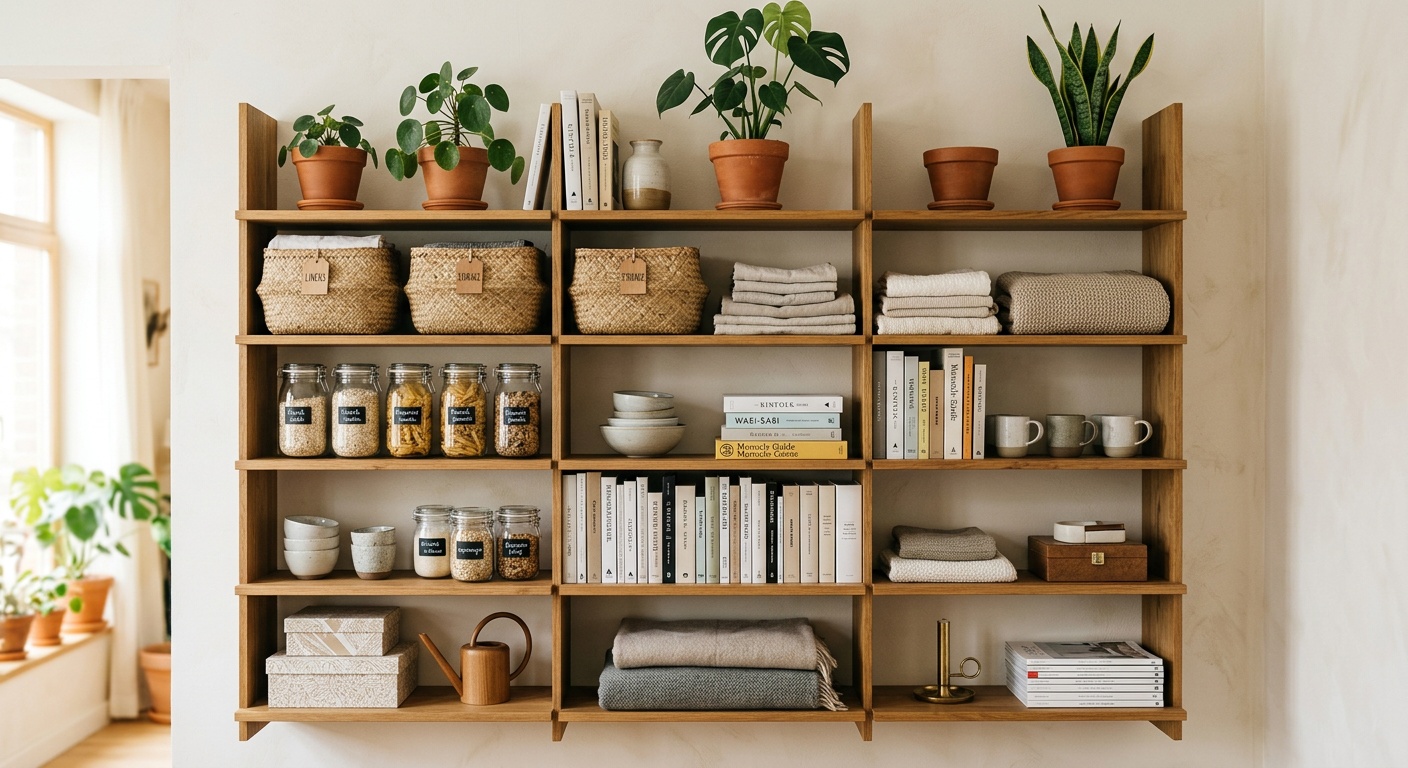
He replaced his standard bed frame with a platform bed featuring 8 storage drawers underneath. His dining table doubled as a desk. Open wall shelving replaced a bulky bookcase, freeing 14 square feet of floor space. A pegboard system in his kitchen eliminated the need for a spice rack and knife block that had taken up an entire counter section.
The most impactful change? A monthly “edit” — 20 minutes on the first Sunday of each month to remove items that had stopped earning their place. Marcus reports that after 12 months, his apartment feels significantly larger than when he moved in, despite adding more belongings. “The system handles the volume,” he told Real Simple. “Nothing accumulates because everything has a defined home and a defined limit.”
How Americans Organize: A 2026 Snapshot
Based on a 2025-2026 survey of 3,500 households by the Home Organization Research Institute, here’s how different organizing strategies rate in terms of reported satisfaction and sustained effectiveness:
Organization Strategy Satisfaction Ratings (% of users reporting “highly effective” after 6 months)
Source: Home Organization Research Institute, 2026 Annual Survey (n=3,500)
Organization Tools: Comparative Guide
Not all storage solutions are created equal. Here’s how the most commonly recommended products from 2026’s top home improvement publications stack up across key performance metrics:
| Solution Type | Avg. Cost | Best For | Durability | Ease of Use |
|---|---|---|---|---|
| Clear Stackable Bins | $8–$25 each | Pantry, closets, garage | ⭐⭐⭐⭐ | ⭐⭐⭐⭐⭐ |
| Pegboard Wall Systems | $30–$80 | Kitchen, garage, office | ⭐⭐⭐⭐⭐ | ⭐⭐⭐ |
| Drawer Dividers (Bamboo) | $12–$22 | Kitchen, bathroom, desk | ⭐⭐⭐⭐⭐ | ⭐⭐⭐⭐⭐ |
| Over-Door Organizers | $15–$45 | Bathroom, pantry, bedroom | ⭐⭐⭐ | ⭐⭐⭐⭐ |
| Modular Shelving Units | $60–$200 | Living room, home office | ⭐⭐⭐⭐⭐ | ⭐⭐⭐ |
Overcoming the 3 Biggest Organization Challenges
Challenge 1: Maintaining the System After the Initial Setup
This is the most universal frustration: you spend an entire weekend organizing, feel triumphant — and then three weeks later, you’re back to baseline chaos. Sound familiar?
The culprit isn’t laziness. It’s system fragility. Most initial organization efforts are built around the “best case” scenario: everyone puts everything away perfectly every time. Real life doesn’t work that way.
The fix is designing for realistic human behavior. Professional organizer and House Beautiful contributor Dana Novak calls this “the path of least resistance principle.” Every storage location needs to be as easy to return to as it is to retrieve from. If putting something away requires three steps when tossing it on the counter requires one, the counter will always win.
Practical solution: Install hooks rather than cabinets for frequently used items. Use open bins rather than lidded boxes for daily-use objects. Design your system around how your household actually behaves, not how you wish it behaved.
Challenge 2: Shared Spaces with Multiple Users
Organization is exponentially harder when multiple people with different habits, aesthetics, and standards share a space. The family home, the shared apartment, the couple with radically different tolerance for clutter — these are the real organizational battlegrounds.
Research from the University of Michigan’s Family Life Research Center (published in late 2025) found that household organization disagreements are among the top five sources of relationship conflict for cohabiting adults. This isn’t trivial.
The editorial consensus from 2026’s home magazines points to individual ownership zones as the solution. Rather than enforcing one system across the entire household, designate personal areas where each person’s organizational preferences reign supreme. Common areas use agreed-upon minimal systems — everything has a home, but aesthetics remain neutral.
Challenge 3: Decision Fatigue During the Decluttering Process
Starting an organization project feels energizing. Two hours in, when you’re staring at 47 items that don’t have obvious homes, you hit a wall. Decision fatigue is real, neurologically documented, and the reason most organization projects stall before completion.
The solution: Use the “four-box method” refined for 2026 realities. Label four containers: Keep Here, Keep Elsewhere, Donate/Sell, Discard. When you pick up an item, you make one of four decisions — no nuance, no lengthy deliberation. Work in 45-minute sessions maximum with 15-minute breaks. This isn’t weakness; it’s neuroscience-aligned productivity.
For items you can’t decide on, Real Simple recommends the “box test”: pack ambiguous items in a sealed box with today’s date. If you haven’t opened it in 90 days, donate it without looking inside. If the box remains sealed, you clearly didn’t need what’s in it.
Tech-Powered Organization: The 2026 Approach
Home improvement magazines have increasingly embraced technology as an organizational ally in 2026 — but with a crucial caveat: technology should support your system, not replace it. Too many apps and smart devices create their own layer of complexity.
The tools worth integrating in 2026 include:
- AI-powered inventory apps: Tools like HomeList AI and Pantry Pal Pro use your phone camera to scan and catalog pantry items, generating shopping lists and flagging expiring products. Better Homes & Gardens named AI pantry management a top 2026 kitchen trend.
- QR-code labeling systems: Replace handwritten labels with QR codes on storage bins. Scan the code to see a digital list of contents — particularly useful for seasonal storage where box contents change annually.
- Smart home integration for cleaning triggers: Setting automated reminders tied to calendar events (“Tuesday = bathroom reset, Sunday = kitchen deep-edit”) builds maintenance habits without relying on memory.
- Digital room planners: Before purchasing any storage furniture, apps like RoomSketcher 2026 and IKEA Place allow accurate virtual placement, preventing expensive mistakes.
A word of caution: Architectural Digest’s tech editor, writing in February 2026, noted that “the average household that invested heavily in smart storage tech without establishing analog systems first reported no meaningful improvement in organization — and significantly higher frustration levels.” The system comes first. Technology amplifies it.
Frequently Asked Questions
How long does it realistically take to organize an entire home?
Most professional organizers in 2026 estimate that a full home organization project — done properly, not just surface-level tidying — takes between 40 and 80 hours of active work, spread across multiple sessions. For a 1,500-2,500 square foot home with average accumulation, expect 4-6 weekends of focused effort. The mistake most people make is attempting to do everything in one marathon session, which leads to burnout and poor decisions. A room-by-room, zone-by-zone approach spread over 6-8 weeks produces far more durable results than a single intense effort.
What should I organize first to get the most immediate impact?
Start with your entryway and kitchen — specifically these two areas first. The entryway is the first and last point of contact in your daily routine, so organizing it creates an immediate sense of calm and reduces morning chaos. The kitchen, meanwhile, is typically the highest-traffic, most emotionally charged space in any home. Visible improvements there generate momentum and household buy-in that makes tackling every subsequent room easier. Avoid starting with sentimental items or attic/basement storage — these high-decision-density areas are best tackled after you’ve built organizational confidence with more straightforward spaces.
Is it worth hiring a professional organizer, or can I do this myself?
It depends significantly on your specific situation. For households dealing with severe accumulation, significant life transitions (divorce, downsizing, bereavement), or chronic disorganization that has resisted multiple DIY attempts, a professional organizer’s investment — typically $65-150 per hour in 2026, or $500-1,500 for a comprehensive project — often pays for itself in time saved and results sustained. For households with moderate organization challenges and sufficient time and motivation, the DIY approach works well, especially when guided by the kind of systematic framework outlined in leading home improvement publications. The key differentiator is accountability: professional organizers provide decision-making support that prevents the stalling most DIY projects experience.
Your Organized Home Action Plan: Where to Go From Here
You now have the framework. The real question is: what happens next? Research consistently shows that people who articulate a specific first action after consuming organizational content are 4x more likely to actually begin the process versus those who finish reading and “plan to start soon.” So let’s make this concrete — for you, right now.
Your 5-Step Implementation Roadmap:
- This week — Audit one room: Choose the space causing you the most daily friction. Spend 20 minutes observing it without touching anything. Identify your zones, note where items currently live versus where they’re actually used.
- Weekend 1 — Zone and declutter: Apply the four-box method to your chosen room. Don’t buy a single product yet. Establish your zones, remove what doesn’t belong, and understand your true storage needs before spending money.
- Weekend 2 — Implement targeted solutions: Armed with accurate knowledge of your space and needs, invest in specific storage solutions. Prioritize visibility, accessibility, and ease of return.
- Month 2 — Establish maintenance rituals: Build a 15-minute weekly reset into your routine. Sunday evenings work well for most households. This single habit prevents 80% of organization backsliding.
- Month 3 — Expand the system: Move to the next room, applying everything you’ve learned. Each room will be faster and more intuitive than the last.
Key Takeaways to carry forward:
- Organization is a system, not a one-time event — design for sustainability, not perfection
- Zone-based thinking is the highest-ROI framework available, applicable to every space
- Your organizational system should accommodate real human behavior, not ideal behavior
- Technology enhances good systems; it cannot replace them
- The first room is the hardest — momentum builds rapidly once you have one success
As homes continue to serve more functions simultaneously in 2026 and beyond, the ability to create intentional, organized living spaces becomes not just a comfort upgrade but a competitive advantage in how you work, rest, and connect with the people who matter most to you.
So here’s the question worth sitting with: Which single space in your home, if organized tomorrow, would most meaningfully improve your daily life — and what’s actually stopping you from starting there today?
Article reviewed by Nina Svensson, Interior Architecture & Color Design Consultant, on July 15, 2026